Benq Unveils DLP-Based HD projectors
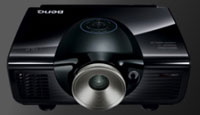
The Benq W6000 1080p projector
|
BenQ recently unveiled three new models in its lineup of high-definition projectors. The new projectors include two 1080p HD systems and one 720p model.
The two 1080p models include the W6000 and the W1000. Both offer a resolution of 1,920 x 1,080. The W6000 sports a brightness of 2,500 lumens and a 50,000:1 contrast ratio. It offers HQV processing to enhance standard-definition images, DynamicBlack and BrilliantColor image enhancement technology, VIDI lighting technology, 10-bit color processing, six-color independent adjustments, horizontal and vertical lens shift, and a 1.5:1 zoom ratio. Video inputs include dual HDMI, component, VGA, S-video, and composite video. Other inputs include USB and RS-232. The W1000 is also a 1080p projector, offering features similar to the W6000 but with a lower brightness (1,800 lumens) and significantly lower contrast ratio (2,700:1).
The W600 is a 720p digital projector that offers a six-segment color wheel BrilliantColor technology to enhance projected images. It boasts a brightness of 2,000 lumens and offers a contrast ratio of 3,000:1. Like the W6000 and W1000, it offers dual HDMI inputs, along with component, VGA, S-video, and composite video inputs.
The W6000 is available now for $3,499. The W1000 and W600 are expected to ship in September. Further information can be found here.