Epson Intros Entry-Level LCD Projectors, Launches Training Series
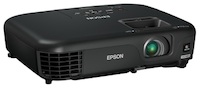
The $650 PowerLite 1261W offers a native resolution of 1,280 x 800. |
Epson has unveiled two portable, entry-level LCD projectors, the PowerLite 1221 and the PowerLite 1261W. The company also launched, in partnership with Discovery Education and Atomic Learning, a new training program to help education users get up to speed on using interactive projection technologies in the classroom.
Both of the new projectors, which were formally introduced earlier this month, come in at less than $700 and offer a brightness of 2,800 lumens and a contrast ratio of 3,000:1. The wide-format PowerLite 1261W has native WXGA resolution (1,280 x 800), while the standard-aspect-ratio PowerLite 1221 has a native XGA resolution (1,024 x 768).
Other features both projectors share in common include:
- ±30 degree automatic vertical keystone correction;
- ±30 degree manual keystone correction;
- Integrated 1 watt speaker;
- AV mute slide and direct power on and off;
- A lamp life of up to 5,000 hours in economy mode; and
- Security features that include a Kensington lock port and password protection.
Both of the projectors weigh in at 5.1 pounds and measure 11.6" (w) x 9" (d) x 3.1" (h).
AV inputs include HDMI, analog RGB/component (mini D-sub 15-pin), S-video, composite video, and stereo RCA jacks. Peripherals and AV outputs include, USB type A, USB type B, and Stereo RCA jacks.
Both projectors will ship in September. The PowerLite 1261W will run $649; the PowerLite 1221 will sell for $549.
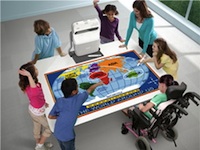
Epson's BrightLink 455Wi can be mounted on a table to create horizontal interactive surfaces. |
In other Epson news, the company this week launched a new suite of training tools for BrightLink and BrightLink Solo users. Designed to help educators in K-12 and higher education understand some of the intricacies of interactive projection technologies, the new tools include webinars to be held on a weekly basis, online videos, and onsite training through Epson resellers.
Epson's BrightLink 455Wi is an ultra-short-throw LCD model capable of projecting an 80-inch (diagonal) image from a distance of 10 inches. It can operate as close as 2.8 inches from the projection surface and can be coupled with an optional table mount to turn horizontal surfaces into interactive tables. The projector itself offers a native WXGA resolution (1,280 x 800 pixels) and a brightness of 2,500 lumens. It includes two digital IR pens (and pen tray) for interacting with projected images.
Further information can be found on Epson's education portal or on the BrightLink for Education product page.