Early Learning Academy Brings Online Curriculum to Preschoolers
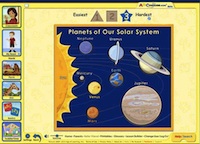
Early Learning Academy's science curriculum includes lessons on planets and the moon. |
Ed tech developer Age of Learning has launched a new online education portal designed for the youngest students. The site, ABCmouse.com Early Learning Academy, brings a full online curriculum to preschoolers and kindergarten students for use in schools and at home.
ABCmouse.com Early Learning Academy provides a range of learning and instructional management tools, such as progress tracking, lesson creation, and a rewards system, in an ad-free environment.
Subject areas include math, reading, art, music, and science, with more than 350 individual lessons covering six academic levels (two each at ages 3, 4, and 5). Topics include:
- Letter recognition, phonics, rhymes, word families;
- Art overview and various art activities, primary and secondary colors, shades of colors;
- Counting, shapes, patterns, greater than/less than, and addition and subtraction concepts;
- Health and biology, plants and animals, astronomy, weather and seasons, and the science of sports; and
- Music appreciation, instrument names, plus learning through music.
The site also offers a range of media, including fiction and non-fiction books in electronic format, music, puzzles, games, and printable worksheets.
ABCmouse.com Early Learning Academy is live now and available on a subscription basis for public schools (classroom, library, and computer lab accounts available, currently free for teachers and librarians), preschools ($99 per year), and families ($79 per year). Further general information can be found here. Subscription information for academic institutions in the United States and Canada can be found here.
| Editor's note: This article has been modified since its original publication to eliminate a point of possible confusion. Previously we wrote, "Subject areas include math, reading, art, music, and science, with more than 350 individual lessons covering six academic levels (two each at ages 3, 4, and 5)." We have eliminated the parenthetical reference to ages. Students of any age can participate in lessons appropriate to their skill level, we are informed. Additionally, we have clarified that the subscriptions for public schools are currently free for teachers and librarians. [Last updated Nov. 18, 2010 at 5:06 p.m.] --David Nagel |