Pennsylvania Elementary School Launches Class-Sized Immersive Simulator
- By Dian Schaffhauser
- 03/14/13
An elementary school in Pennsylvania will shortly be immersing their students in a real-life "Magic School Bus" to help them learn science, technology, engineering, and math (STEM) topics, along with critical thinking, problem solving, and teamwork. Shaler Area Elementary School in Glenshaw is applying an $80,000 grant to work with Dream Flight Adventure in converting a classroom into the "IKS Titan," an interactive learning environment that uses iPads, a Promethean board, a projector, and other technology.
Described by Dream Flight Adventures Director Gary Gardiner as "part simulator, part game, and part theater," the environment allows students to be "sent" on missions created by the school's teachers. The missions involve history, literature, and the humanities along with STEM concepts, to explore outer space, undersea voyages, or trips to the past. Each student will play a role: captain, first officer, pilot, biologist, physicist, engineer, hacker, or one of seven other stations. The simulator can support groups of four to 16 players at a time.
| | 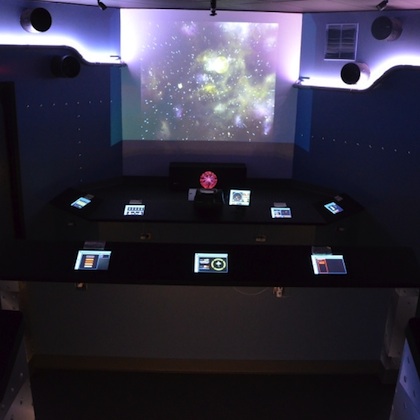
Shaler Area Elementary School's IKS Titan will allow groups of four to 16 students to complete cross-curricular missions. | |
During regular classes and for special projects, groups of students will climb into the simulator and learn how to operate the technology controls to apply that knowledge in pursuit of their mission. Each player has a specific station with several tasks. Then they come together to work as a team to accomplish the mission.
"Shaler Area School District has committed itself to interdisciplinary learning and development of 21st Century skills among our students, and Dream Flight Adventures will be instrumental in taking this effort to the next level," said Superintendent of Schools Wes Shipley.
"It's the ultimate cross-curricular activity," added Math and Science Teacher Joe Malloy.
Funding was provided by the Grable Foundation. The first group of test pilots will be students participating in Shaler's Gifted and Talented Education program. From there, usage will expand to all students in fourth through sixth grade.
"The IKS Titan classroom simulator makes learning fun and memorable and inspires students to develop greater knowledge and skills in STEM, the arts, and humanities," noted Principal Cindy Foht. "We're excited because the students are excited."
The IKS Titan takes off on its maiden voyage on March 20, 2013.
About the Author
Dian Schaffhauser is a former senior contributing editor for 1105 Media's education publications THE Journal, Campus Technology and Spaces4Learning.