Drill Down

As smart phone usage rises, applying the devices in education grows imperative. Speak Up 2006 showed smart phone ownership at 9 percent among both middle and high school students. The 2008 data: 24 percent for middle schoolers, 28 percent for high schoolers.

HIGHLIGHTS:

  • Teachers report less ownership of smart phones than both high school and middle school students.
  • Smart phone ownership among students in kindergarten through second grade is nearly equal to that of teachers.
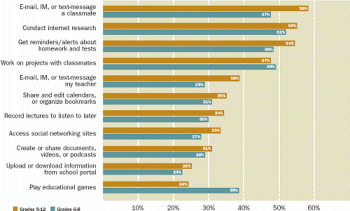
  • Middle schoolers are more interested than high schoolers in using handheld devices to play educational games.

Do you own a smart phone, such as a BlackBerry or an iPhone?
(Percentages indicate number of respondents who answered yes.)

Drill Down (thumbnail)


How would you prefer to use your mobile device for schoolwork?
Drill Down (thumbnail)


Drill Down--Data courtesy of Speak Up 2008, an annual national research project that surveys K-12 students, teachers, parents, and administrators. Speak Up is produced by Project Tomorrow, a national education nonprofit organization providing leadership, research, and programming to support science, math, and technology education in America’s schools.

This article originally appeared in the 8/1/2009 issue of THE Journal.

Comments

Thu, Jan 13, 2011 Mechelle Alabama

I agree with Greg and add many students K-2nd grade may not know the difference between a cell phone and a smart phone. All three of my children own cell phones only because they get old phones that are no longer activated to play with. My children thought all phones had internet access until I explained it to them.

Mon, Nov 2, 2009 Greg Michigan

Nearly 2 out of 10 K-2nd graders reported "owning" smart phones? How is ownership defined - are these actually students' smart phones or are the students reporting on their parents' devices? If the students are reporting that they possess the smart phones, I must live in an area not represented by survey respondents. I know a good many K-2 students; I can't think of a single one who has their own phone, smart or otherwise.

Add your Comment

Your Name:(optional)
Your Email:(optional)
Your Location:(optional)
Comment:
Please type the letters/numbers you see above

White Papers:

  • Desktop Virtualization in K-12 Schools: Reducing Costs, Saving Time And Delivering Anytime, Anywhere Access for Students and Staff PDF screen shot

    This paper will show how desktop virtualization can positively position educational institutions for the future, enabling them to reduce expenses through hard dollar savings and time efficiencies while delivering the experience that students, faculty and staff need and desire. Through the experiences of Babylon School District, as well as Manchester Essex Regional School District in Massachusetts and Rockford Public Schools in Michigan, we’ll paint a picture of how desktop virtualization can revolutionize education’s approach to delivering technology — an approach schools can actually afford. Read more...