1Million Project to Close Homework Gap for 180,000 Students This School Year

About 70 percent of high school teachers assign homework that requires some online activity, yet millions of families in the U.S. with school-age children lack internet access at home. For the 2017-2018 school year, Sprint launched a nationwide campaign aimed at closing the homework gap for these students.

Through Sprint’s 1Million Project, the company has ambitiously committed to providing 1 million high school students living in low-income households with free and connected smartphones, tablets and hotspot devices.
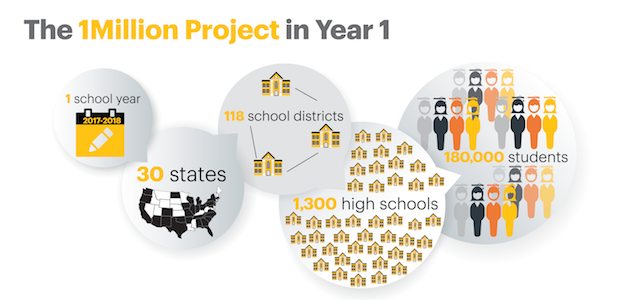
The 1Million Project began last year, when Sprint piloted the project across 11 cities and distributed devices to 4,000 students.

Now, for the inaugural year of the five-year program, around 180,000 students at more than 1,300 high schools will receive one of the aforementioned devices equipped with 3GB of high-speed LTE data per month for up to four years while they are in high school, according to information from the company.

The initial launch includes high schools located across 32 states, with an additional 62 set for activation in New York near the end of September.

To learn more, watch the project overview video below or visit the 1Million Project site.

About the Author

Sri Ravipati is Web producer for THE Journal and Campus Technology. She can be reached at [email protected].

Featured

  • teacher holding laptop in the class at school

    80% of Teachers Are Using AI Tools in the Classroom

    In a recent survey by PreK-12 marketplace TPT, 80% of educators reported using generative AI tools in their classrooms. The majority (58%) said they use AI regularly or occasionally, while 22% have tried it once or twice.

  • Digital cyberspace with particles and Digital data

    Survey: AI Is Moving Faster than Data Trust

    AI agents are already in use or pilot at most organizations, but data visibility, governance and precision recovery capabilities have not kept pace, according to a new survey from Veeam Software.

  • Neon blue security locks with a single red highlight

    With AI, Cybersecurity Focus Shifts from Finding Flaws to Fixing Them

    For decades, one of cybersecurity's biggest challenges has been finding vulnerabilities before attackers do. A growing number of security professionals now say artificial intelligence is changing that equation, shifting the focus from discovering flaws to fixing them quickly enough to prevent exploitation.

  • Human Hand Assembling Digital Data Blocks

    Report: AI Impact Starts Relies on Strong Data Foundation

    High-impact AI implementations are more likely to treat data architecture, governance, and operationalization as strategic requirements, according to the 2026 Blueprint report from TDWI.