Students Blow through Wind Power in Free Virtual Lab

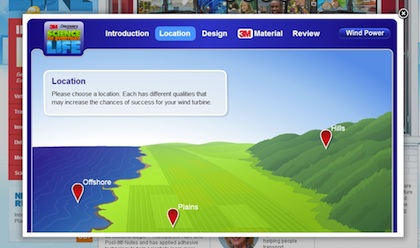
A new free virtual lab teaches students in grades 9-12 how turbines work to generate wind energy. Introduced by Discovery Education and 3M on a joint site, Science of Everyday Life, the inquiry-based learning lab challenges users to create a turbine that will supply 400 homes with electricity for a year at the highest efficiency and lowest cost.

A 22-page teacher guide explains that a virtual lab allows students to tackle "real-life problems" in a "virtual environment." This lesson, which can be done in three or four class periods, provides students with experience in engineering design and redesign, testing, research and data collection. The experimentation requires them to examine how location and blade design affect turbine efficiency.

  The Science of Everyday Life site asks students to examine how location and blade design affect turbine efficiency.
The Science of Everyday Life site asks students to examine how location and blade design affect turbine efficiency.
 

Other lessons for the same grades cover the impact of population growth and energy demands and food safety. The same site includes science activities for students in grades K-2, 3-5 and 6-8.

About the Author

Dian Schaffhauser is a former senior contributing editor for 1105 Media's education publications THE Journal, Campus Technology and Spaces4Learning.

Featured

  • lock symbol with quantum bits in dynamic motion

    Microsoft Accelerates Quantum-Safe Security Timeline

    Microsoft is speeding up its quantum-safe security timeline, noting that advances in quantum computing and new federal requirements have pushed post-quantum cryptography from a future planning issue into an immediate engineering priority.

  • abstract colored blocks

    OpenAI Letting Go of Sora Short-Form AI Video Platform

    OpenAI is reportedly getting rid of Sora, its generative AI model that creates short video clips from text prompts, images, or existing video inputs. The move upends the company's December partnership with The Walt Disney Company.

  • digital lock with circuit patterns

    IBM Adds New AI-Powered Cybersecurity Tools

    IBM has unveiled an expanded portfolio of AI-powered cybersecurity products, positioning the company to compete more aggressively in a rapidly evolving market where enterprises are increasingly turning to artificial intelligence to defend against automated cyber threats.

  • digital file folder with padlock symbol

    FERPA Was Written for File Cabinets, Not Cloud Servers

    Passed in 1974, FERPA was never meant to govern cloud-based platforms, artificial intelligence, or the invisible flow of student data across third-party vendors. Our students deserve better.