South Dakota College Students Use Pokemon Go to Teach STEM to Fourth Graders
Did you know that Pikachu, Squirtle, Eevee and Mewtwo can help teach science, technology, engineering and math (STEM) concepts to elementary school kids?
The popular Pokémon Go characters are part of a project at Dakota State University (DSU) in Madison, SD. Juniors in a technology in education class used the smartphone-based augmented reality game late last month to teach local fourth graders concepts such as photosynthesis, gravity and the transformation of electricity.
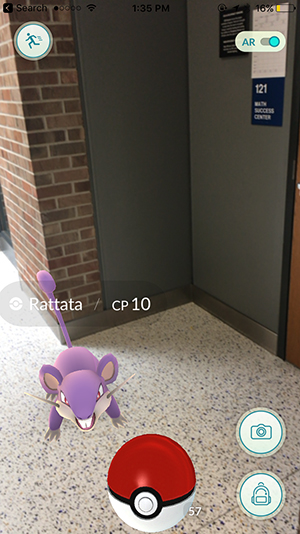
The children from St. Thomas School in Madison actually came up with the STEM ideas. They accompanied the college students to Memorial Park near campus to find the Pokémon creatures and also make STEM-related observations with the augmented reality images they captured. No modifications were made to the location-based game, developed by Niantic.
“We started with the Pokémon Go framework,” said Mark Geary, associate professor at DSU, the ed tech course’s instructor. “We’re trying to place the characters in a backdrop that had STEM significance.”
After the children found the creatures and captured images, they returned with Geary’s students to DSU to make concrete STEM-related observations and calculations. They explored photosynthesis in the grass and leaves, the math behind building a bridge, gravity involved with the slide in the playground, and friction between a road and car tires.
The children “got very, very engaged with it very rapidly,” Geary said. “My students were not super excited themselves, but were interested in how it engaged those fourth graders — how engaged and how fast the fourth graders got involved with the product.”
Geary doesn’t know if he’ll return to the Pokémon Go project early next year, because his “spring course is online. It’s challenging to do it in the online format.”
But he definitely predicts returning to Pokémon Go next fall.
“Augmented reality is just going to progress from here on out,” he said. “There are tons of opportunities as far as augmented reality is concerned. The game has worked, and they’re going to come up with their own variations. Every class is going to figure out something different.”
Geary also sees potential for other instructors to use Pokémon Go in their classrooms.
“The teachers are going to invoke their own creativity in it,” he said.
About the Author
Richard Chang is associate editor of THE Journal. He can be reached at [email protected].