Google Expeditions Adds Augmented Reality for Classrooms
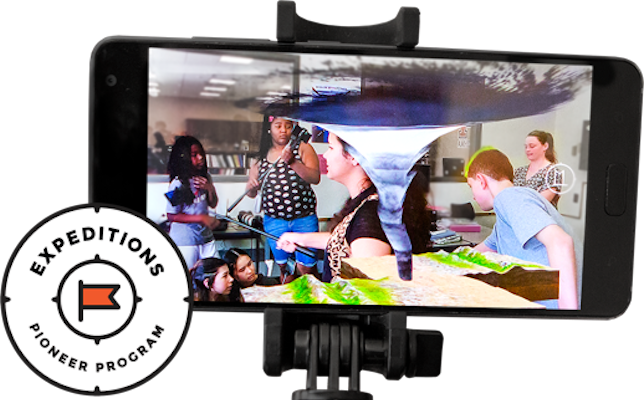
Image Credit: Google.

At Google’s annual developer conference this week, Google I/O 2017 (May 17-19), the company revealed plans to bring augmented reality (AR) to its immersive education platform Google Expeditions.

The upcoming Expeditions AR mode harnesses Google’s Tango AR platform, which uses Visual Positioning Service (VPS) technology to map indoor locations. With a Tango-compatible device, such as the Lenovo Phab 2 Pro, the camera will utilize VPS to recognize specific objects and landmarks. Expeditions AR will enable students to see 3D models of objects like volcanoes, DNA molecules and more up close in a virtual environment.

Expeditions AR lessons will be available to schools this fall through a Pioneer Program. Interested teachers, administrators and other individuals can sign up now.

Just two years ago at I/O, the company unveiled Google Expeditions for the 2015-16 school year as part of an effort to bring low-cost, virtual field trips to the classroom. The company said that more than 2 million students worldwide have experienced virtual reality in Expeditions with Google Cardboard.

To see how Expeditions AR could be used in the classroom, watch the video below.

About the Author

Sri Ravipati is Web producer for THE Journal and Campus Technology. She can be reached at [email protected].

Featured

  • tool icons with variety of business icons

    SETDA Releases Free EdTech Quality Action Toolkit

    The State Educational Technology Directors Association (SETDA) has put together a free K-12 EdTech Quality Action Toolkit that provides a framework for evaluating education technology products as well as guidance on regulatory compliance, templates for communicating with vendors, training resources, and more.

  • woman working with computer laptop with polygonal brain shape of an artificial intelligence and various icons

    13 School and District Teams to Participate in Rural AI Strategy Lab

    K-12 education nonprofit FullScale, in partnership with nonprofit advocacy organization All4Ed, is bringing together 13 school and district teams to collaboratively investigate how AI can thoughtfully be integrated into teaching and learning.

  • children sitting on white chairs, holding up colorful speech bubbles

    Why Title III Is Lacking in Today's Multilingual, Technology-Enhanced Classrooms

    When Congress strengthened Title III in the early 2000s, the focus was helping students acquire English and access academic content. That goal remains important, but the classrooms of 2026 look very different from those of 2001.

  • abstract colored blocks

    OpenAI Letting Go of Sora Short-Form AI Video Platform

    OpenAI is reportedly getting rid of Sora, its generative AI model that creates short video clips from text prompts, images, or existing video inputs. The move upends the company's December partnership with The Walt Disney Company.