Report: Blended Learning Requires Modification and Flexibility
Rote obedience isn’t the way to successfully implement a blended learning model, according to a new case study focused on schools in Colorado and Washington, D.C. that illustrates the importance of flexibility to provide more personalized experiences for each student.
When Angela Jones taught fourth grade English language arts (ELA) at Bella Romero Academy (Greeley, CO), she encountered the need to change a blended learning model she was using. She quickly found that having fixed times for the learning software she used wasn’t working for her students.
During the 2014-15 school year, Jones started to use the “Station Rotation” model – one of seven blended learning models developed by the Clayton Christensen Institute in 2012. It’s suited for large classroom sizes where it may be challenging to personalize and differentiate instruction for individual students. Rather than go vertically down a checklist of tasks for the day, the model encourages teachers to “go horizontal” and have several learning stations going at once — with at least one station being an online learning station.
Station Rotation
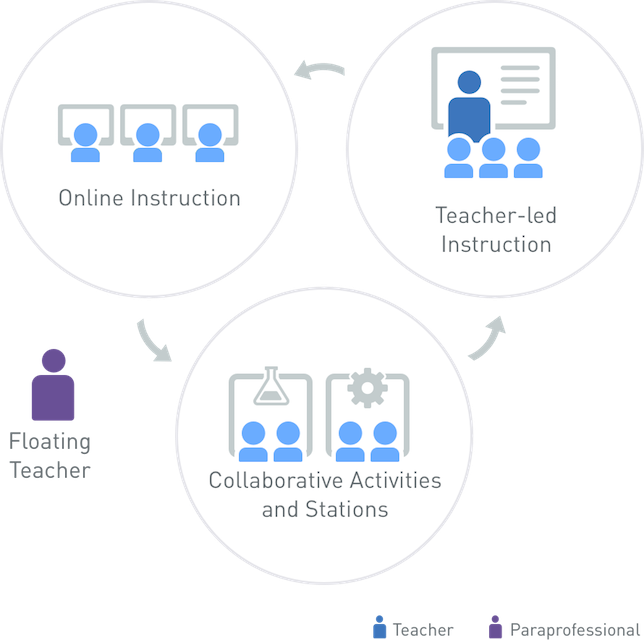
Image Credit: Clayton Christensen Institute.
She set up three stations: One with the online math curriculum Zearn; another with the i-Ready online adaptive reading assessment from Curriculum Associations; and the last one with the online reading and writing curriculum tool Achieve3000. She set aside 40 minutes of online content, 20 minutes of independent or collaborative learning, and 20 minutes of teacher-student time. However, Jones quickly discovered that not every student was able to keep pace with the time allotted. Instead, she started using individualized student “playlists” and other methods that proved more effective. Now a coach at Bella Romero, she helps other teachers manage a less rigid blended learning approach.
More K–12 schools are implementing blended learning models in hopes of providing personalized education for students. However, to meet this goal, teachers must continually modify and evolve these models, as Jones had, according to new research. She’s one of five teachers at Bella Romero as well as the District of Columbia Public Schools in Washington, D.C. highlighted in a newly released case study. “Blended (R)evolution” focuses on teachers working to identify and pursue new ways to modify instructional models that will optimize the learning process for their students. It builds on five years of research conducted by the Clayton Christensen Institute.
Bella Romero is a school where 93 percent of the students are on free and reduced-price lunch and 55 percent have been identified as English language learners (ELL), according to the report. The principal at Bella Romero Academy, John Cooney, decided for the 2014-15 school year to tap technology to customize learning to each student’s needs and strengths. Cooney recruited several teachers (mentioned in the report) and encouraged changes to the Station Rotation model, the “Flex” model and other blended learning models designed by the Christensen Institute.
“We found that kids enjoyed the idea of being in the driver’s seat,” Cooney told the Christensen Institute. “But that was the biggest challenge: It was hard to guarantee their learning. It was difficult to ensure kids were developing competency before moving forward, and we didn’t have tight enough feedback loops when students were all moving at their own pace.”
Cooney helped introduce the concept of “iteration in moderation,” as discussed in the case study, which applies three core principles:
- Student agency;
- Tight feedback loops; and
- Targeted instruction.
Applying this process helped “unlock innovations within and beyond the original Station Rotation model,” the report states.
“Blended (R)evolution” is written by Clifford Maxwell and Jenny White, who manage the Christensen Institute's Blended Learning Universe, an online resource hub for blended learning. BLU, for instance, has a school directory that contains more than 500 blended learning programs at schools worldwide. The hub also offers free practical guides for educators to use.
Access the full case study on the Christensen Institute site.
About the Author
Sri Ravipati is Web producer for THE Journal and Campus Technology. She can be reached at [email protected].