Educators, Policymakers Say Problem Solving is Important, Not Emphasized in School
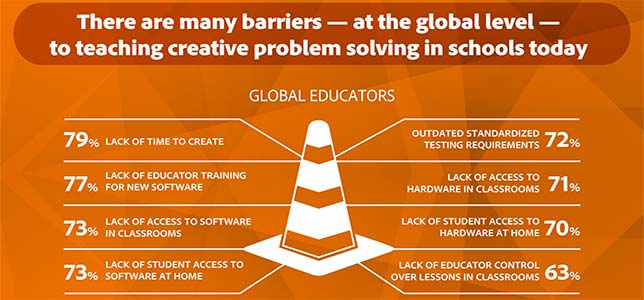
Source: Adobe survey of educators and policymakers, January 2018.
Nearly all educators and policymakers, 97 percent and 96 percent, respectively, say that it's important for students to learn creative problem-solving skills in school, according to a new international survey from Adobe. But approximately two-thirds — 69 percent of educators and 60 percent of policymakers — say that current curricula do not emphasize creative problem solving enough.
The groups surveyed agreed that jobs requiring creative problem solving are less likely to be affected by automation (76 percent of educators and 74 percent of policymakers), that students who excel at creative problem solving are more likely to have higher-earning jobs (86 percent for educators and 85 percent of policymakers) and that such skills are currently in high demand among senior level and higher paying positions (85 percent of educators and 84 percent for policy makers).
Despite agreement that problem solving is important, the skills educators identified as important components in problem solving are not emphasized enough. For example, 67 percent of educators surveyed said independent learning is important, but only 23 percent said it is adequately emphasized. The same is true of learning through success and failure (61 percent versus 16 percent), working with diverse teams (60 percent compared to only 24), self-expression and dialogue (57 versus 21 percent), persistence and entrepreneurial spirit (55 percent to just 14 percent), accepting challenges and risk taking (55 percent versus 13 percent), argument and conflict management (52 percent compared to 12 percent) and innovative thinking (48 percent and just 12 percent).
"There is a clear gap between what educators and policymakers know tomorrow's workforce needs, and what today's students are learning in school," said Tacy Trowbridge, global lead for education programs at Adobe, in a prepared statement. "Educators, policymakers and industry — technology in particular — need to come together to improve opportunities for students. Creative technologies can help educators teach and nurture critically important 'soft' skills, and policies and curricula need to evolve to complete the equation."
Other key findings of the report include:
- 79 percent of teachers surveyed said they lack time to create;
- 77 percent of educators told researchers they don't receive adequate training on new software;
- 73 percent of educators surveyed said they have inadequate access to software in their classrooms and the same percentage said their students lack adequate access to software at home;
- 72 percent said they are responsible for meeting outdated testing requirements;
- 71 percent said they do not have access to appropriate hardware in their classrooms and 70 percent said their students lack access to the right hardware at home;
- 63 percent of teachers surveyed said they don't have enough control over their own classroom lessons; and
- 80 percent of educators surveyed from the United States said current policies hurt their ability to nurture problem solving.
In related news, Adobe is launching three new offerings related to its Creative Cloud and Spark tools beginning in April in an effort to "help foster the teaching of creative problem solving and improve accessibility for education institutions to its creative tools and services," according to a news release.
The company will offer Spark Premium, normally $120 per year, for free to schools and universities. The company will also grant access to Creative Cloud to students under the age of 13 in compliance with COPPA regulations. And Adobe will launch a new school ID integration to allow for single sign-on at school and at home.
To access the full report, visit cps.adobeeducate.com.
About the Author
Joshua Bolkan is contributing editor for Campus Technology, THE Journal and STEAM Universe. He can be reached at [email protected].