Behavior Management: Classroom Prototype Display Helps Kids Get on Track
- By Dian Schaffhauser
- 05/28/19
Researchers at the University of Michigan and other institutions have examined the challenges of teachers implementing behavior management strategies and come up with a classroom display prototype that can be used by students themselves.
According to Gabriela Marcu, an assistant professor at U Michigan's School of Information, problems surface particularly as teachers are working with students with disruptive behaviors. The work done in the classroom needs to be reinforced at home, but that requires good communication, and traditional methods such as paper notes or email don't always get across effectively.
Marcu and colleagues from her own institution as well as Drexel University and the University of Washington conducted research with teachers and parents of students receiving behavioral and mental health services to address autism spectrum disorders, attention deficit hyperactivity disorder and other needs. By law, these students receive individual education plans that call for documentation of progress toward goals stated in the plan. Yet, communication breakdowns often mean parents rarely hear about progress or outcomes.
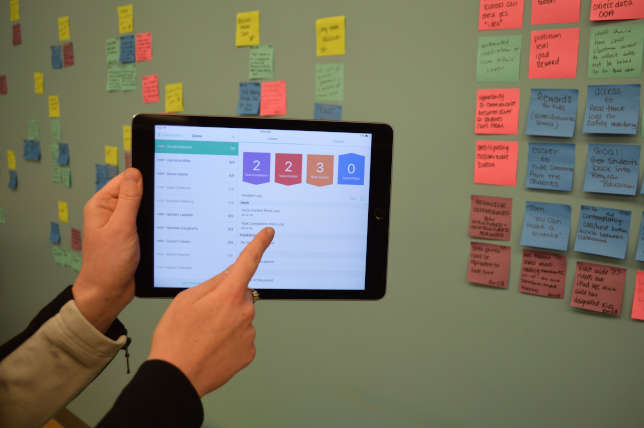
An iPad app lets students earn points for safe and appropriate behaviors, using categories that help students understand what is expected of them. Source: University of Michigan
As described in a paper presented at the ACM CHI Conference on Human Factors in Computing Systems, the research team talked with educators and parents in the United States and Sweden over 30 months and 265 hours of observation, interviews and focus groups, to find out how the communication normally occurred. Among the concerns were these:
-
Parents had little face-to-face time with educators, preventing both parties from building a working relationship;
-
Communications was never guaranteed to get through, or if it did, the information would be seen too late for families to do anything about specific problems;
-
Teachers would learn that sometimes if they fully shared information about troublesome behaviors at school, family conflict would result; and
-
The communication exchange would usually go just one way, especially if paper were the medium.
While two-way communication was preferred, the use of various applications and websites to facilitate that didn't always meet the needs of educators or families, Marcu found. As a result, she and the rest of the team are developing new apps together with parents, educators and usage by the kids themselves to improve the designs of these programs. One such prototype is intended for student use.
"The goal was to give children more agency over their success," Marcu said, in a university article about the project.
This classroom display gives students custom feedback about how they're doing toward personal behavioral goals. The first version of the prototype was used in a first-grade classroom over 10 months of a school year.
In a separate paper delivered at the PervasiveHealth 2019 conference, Marcu described an approach in which the teacher uses an iPad app to give students points for safe and appropriate behaviors, choosing categories that help students understand what physical, verbal and social behaviors are expected of them. A display mounted on the wall at the front of the room shows a cartoon frog for each student in the class, each sitting on a lily pad. Whenever the teacher logs a point using the app, the student gets a notification through a frog in a pop-up message and sound effect. Students trade their points in at the end of the day for a reward, and the program resets for the next collection cycle.
"We were definitely concerned about this backfiring, and that publicly displaying this type of information could lead to students feeling embarrassed or shaming one another about their behaviors. But that is where careful design comes in, by developing these technologies together," Marcu said. "What we found was that the display was so positive and encouraging that it actually led to students supporting one another to meet their goals."
Now the team hopes to have the application refined for further testing in a larger number of classrooms.
About the Author
Dian Schaffhauser is a former senior contributing editor for 1105 Media's education publications THE Journal, Campus Technology and Spaces4Learning.