Study: Large Print Books Boost Comprehension Skills
Teachers are increasingly adding more online learning tools into their classrooms in an effort to increase student engagement, but a new study finds that students get the most benefit from reading large print books. Sixty-one percent of "striving readers" enjoy reading large print books and 63 percent of those readers believe that those books improved their comprehension skills.
This research comes out of a report produced by Project Tomorrow on behalf of Gale's Thorndike Press. The study surveyed nearly 1,700 students in grades 3-12 and 56 teachers and librarians across 15 U.S. elementary, middle and high schools.
"Findings from this study reveal improved self-efficacy around reading, changed reading habits and new outcomes from the experience of reading large print," said Project Tomorrow CEO Julie Evans, who led the research project. “It's important to note that reading large print books not only improved students’ reading skills, it also improved their attitude toward reading."
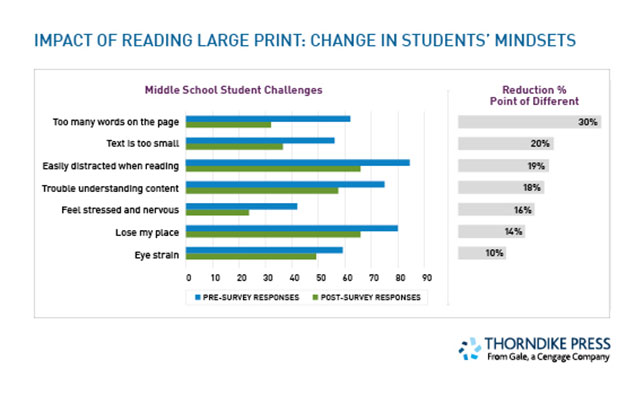
When it comes to test scores, researchers found a correlation between large print books and assessment results. Based on data collected from Achieve3000, a third grade class in a urban elementary school in Texas saw a 120 point increase in Lexile reading levels from the start to end of the school year. Forty-five percent of the students in the class identified as English language learners.
Other findings from the survey include:
- 61% of elementary school students said they remembered characters and plots better when reading large print books.
- 48% of high school students said they read more outside of school after experiencing large print books.
- Middle school students reported a 43% reduction in feelings of anxiety about reading when using the large print format.
- 67% of teachers noted that large print text reduced stress and anxiety in students reading below grade level and at grade level.
- 80% teachers said large print would benefit their students who have trouble tracking when reading or lack self-confidence in their reading abilities.
- 95% of teachers said they're likely to use large print in the upcoming school year with their students.
- 75% of teachers said that large print books are now an integral part of their classroom collections.
The full copy of the study is available with registration on Gale's website.
About the Author
 Sara Friedman is a reporter/producer for Campus Technology, THE Journal and STEAM Universe covering education policy and a wide range of other public-sector IT topics.
Friedman is a graduate of Ithaca College, where she studied journalism, politics and international communications.
Friedman can be contacted at [email protected] or follow her on Twitter @SaraEFriedman.
Click here for previous articles by Friedman.