UltiMaker Launches Differentiated Learning Platform, Announces New MakerBot Grants
 MakerBot Nebula
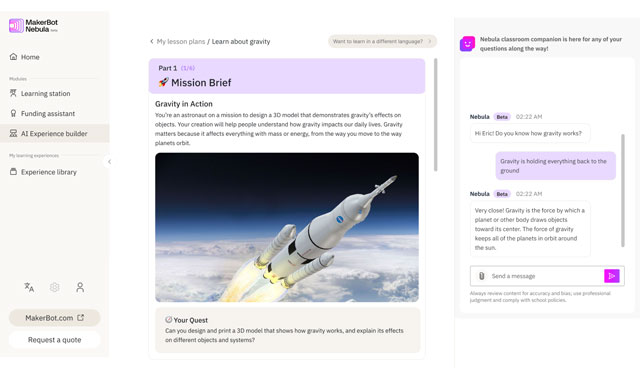
UltiMaker, a provider of 3D printing solutions for education, has launched an AI-powered differentiated learning platform designed for STEM learning. Dubbed MakerBot Nebula, the platform combines 3D printing, educator support, and personalized learning tools centered on "learning through making."
"We've seen, firsthand, how 3D printing brings STEM learning into the classroom, opening doors to design thinking and problem-solving," commented Dottie Stewart, VP of sales America & global education strategy at UltiMaker, in a statement. "But as classrooms become more demanding and students' needs more diverse, tools alone aren't going to be enough. That's why we created MakerBot Nebula, a new kind of learning platform that connects technology, pedagogy, and creativity in one seamless experience."
Tools within MakerBot Nebula include:
- Learning Station, a professional learning hub to help educators develop their teaching skills, learn how to set up and operate UltiMaker and MakerBot 3D printers, and apply best practices for utilizing 3D printing and other technologies in the classroom;
- Experience Builder, a tool for creating flexible, standards-aligned learning pathways, including support for student pacing, style, and progress tracking; and
- Funding Assistant, a built-in resource for connecting educators to grant opportunities and AI-powered grant-writing assistance.
The platform is currently free for beta users.
In conjunction with the MakerBot Nebula platform launch, UltiMaker has opened the application period for this year's MakerBot Grants, an opportunity for K-12 educators across the United States and Canada to bring $4,000 worth of 3D printing materials into their classrooms. Each grant winner will receive:
- One MakerBot Sketch Sprint 3D printer;
- 20 spools of PLA filament;
- One copy of the MakerBot Educators Guidebook;
- Classroom Certification (seats for one teacher and 30 students); and
- A three-year UltiMakerCare service plan for the MakerBot Sketch Sprint 3D printer.
A minimum of 10 grants will be awarded through the end of 2025. Selection criteria include student impact, financial need, innovation, and readiness to integrate 3D printing into the classroom. For more information and to apply, visit makerbot-nebula.com.
About the Author
Rhea Kelly is editor in chief for Campus Technology, THE Journal, and Spaces4Learning. She can be reached at [email protected].