NEC Intros Ultra-Short-Throw Interactive Projector Bundles
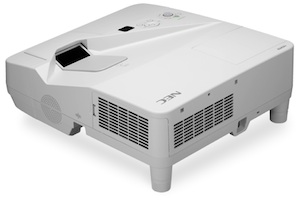
The new NEC UM-series projectors offer up to WXGA resolution and a 3,300-lumen brightness rating.

This January NEC will ship two new ultra-short-throw LCD projectors, both to be available with in bundles that provide interactivity using the company's eBeam technology.

The UM330X is an XGA-resolution projector (1,024 x 768 pixels) with a brightness of 3,300 lumens and a contrast ratio of 3,000:1. The UM330W has a native WXGA resolution (1,280 x 800 pixels) but is otherwise nearly identical to the UM330X.

Both are designed for extremely short throw distances, as little as 17.64 inches to produce a 58-inch (diagonal) image on the UM330U and a 61.5-inch image on the UM330X. They're also designed to be used with the optional NP02Wi eBeam interactive system, which allows for functionality similar to that of an interactive whiteboard using a small receiver and compatible stylus.

Other features include:

  • 1.4x zoom;
  • Wired and optional wireless LAN;
  • USB viewer;
  • Closed captioning support;
  • Integrated wall color correction;
  • Automatic or manual keystone correction ±10 degrees;
  • Carbon savings meter;
  • Virtual remote; and
  • Integrated 16 watt speaker.

AV inputs includedual HDMI, RGB (mini D-sub 15-pin), S-video, composite video, mic, and stereo minijack. AV outputs include monitor out (mini D-sub 15-pin) and variable audio out (minijack). Networking and control ports include wired LAN (RJ-45), optional wireless LAN, three USB ports, RS-232, IR, and DDC/CI. The units measure 16.9" (w) x 23.3" (d) x 4.4" (h) and weigh in at 12.6 pounds.

The UM330X and UM330W will both be available in January. The XGA UM330X will run $1,099 as a standalone unit or $1,299 with a wall mount bundle. The WUXGA UM330W will sell for $1,318 individually or $1,518 with a wall mount bundle. The eBeam NP02Wi sells for $489. Additional details can be found on NEC's projector portal.

About the Author

David Nagel is the former editorial director of 1105 Media's Education Group and editor-in-chief of THE Journal, STEAM Universe, and Spaces4Learning. A 30-year publishing veteran, Nagel has led or contributed to dozens of technology, art, marketing, media, and business publications.

He can be reached at [email protected]. You can also connect with him on LinkedIn at https://www.linkedin.com/in/davidrnagel/ .


Featured

  • abstract colored blocks

    OpenAI Letting Go of Sora Short-Form AI Video Platform

    OpenAI is reportedly getting rid of Sora, its generative AI model that creates short video clips from text prompts, images, or existing video inputs. The move upends the company's December partnership with The Walt Disney Company.

  • blue wooden cubes block texture abstract background

    Gartner: Worldwide IT Spending Estimated at $6.31T for 2026

    According to a Gartner forecast, worldwide IT spending will total $6.31 trillion in 2026, a 13.5% increase from 2025. Sectors experiencing the largest growth include data center systems, software, and IT services.

  • large cloud icon on the right in an abstract world above a polygon with a dark blue background

    Cloud Security Alliance Expands Agentic AI Governance Work

    The Cloud Security Alliance (CSA) has announced a series of CSAI Foundation milestones aimed at securing what it calls the agentic control plane, including a new catastrophic risk initiative, CVE Numbering Authority authorization, and the acquisition of two agentic AI specifications.

  • Neon blue security locks with a single red highlight

    With AI, Cybersecurity Focus Shifts from Finding Flaws to Fixing Them

    For decades, one of cybersecurity's biggest challenges has been finding vulnerabilities before attackers do. A growing number of security professionals now say artificial intelligence is changing that equation, shifting the focus from discovering flaws to fixing them quickly enough to prevent exploitation.