NJ School Uses 3D Printing in Multiple Classes
3D
printing
has found its way into multiple classes at the Hun
School of Princeton in New Jersey.
With
two
3D printers available in the science and visual arts departments of the
private school in central New Jersey, its 600-plus students and teachers
are
finding uses for them in everything from visual artistry and
mathematical
discovery to their own scientific research and development of
problem-solving
skills.
"We
are
just beginning to explore the ways in which 3D printing can be used in
an
academic setting," said Hun School Science Chair Bernard HP
Lockhart-Gilroy.
Examples of how the technology is being used at the school include:
- In
his physics class, Lockhart-Gilroy is using
it to model three-dimensional geometric shapes. "It's
difficult
to conceive three-dimensional representations of mathematical
functions,"
he said. "Now we can give the printer an algorithm or formula and we can
make it."
- Last
year, the human anatomy and physiology
class used 3D prints of bones to scale them to the size they needed,
using
computer-generated artwork.
- Two students used it to test a
theory that the
shape of batteries affects their lifespan and, after plating the 3D
printed
shapes with silver, effectively made their own batteries.
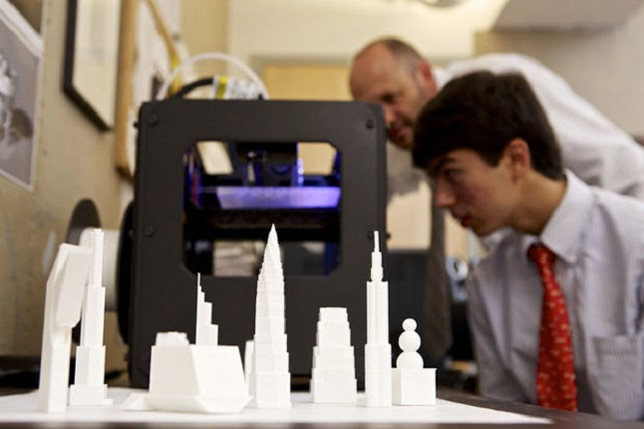
- In the visual arts department's
computer-aided
design (CAD) course, students and teachers created three-dimensional
models to
make representations of architectural renderings, sculptures and
personal
objects.
"In
the
visual arts department, we focus on the creative side of design," said
art
teacher Allan Arp, "but, from a practical sense, CAD can be used in
conjunction
with 3D printing for many practical purposes."
About the Author
Michael Hart is a Los Angeles-based freelance writer and the former executive editor of THE Journal.