Updated MakerBot App Turns 2D Images Into 3D-Printable Files
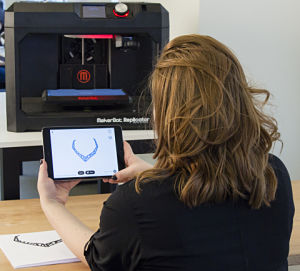
MakerbotThe free iPad app MakerBot PrintShop version 1.5 is now available in the iTunes App Store. Version 1.5 offers a new feature called Shape Maker that turns 2D images into 3D-printable files. Designed for beginners who want to get started quickly with 3D printing, Shape Maker allows users to transform sketches, photos and screen captures into files that can then be sent to a variety of MakerBot printers. 

To get started with Shape Maker on MakerBot PrintShop, users open the app, select Shape Maker and use the iPad’s camera to snap a photo of a drawing or an item that has a distinct contrast and simple lines. The slider tools help select the areas of the drawing to 3D print and scale. When all of the items or lines to be printed turn green, users can choose a background and then select print or save right from the screen. 

Saved files are stored in the MakerBot Cloud Library and can be accessed through personal accounts on Thingiverse, the design site for viewing, sharing and 3D printing digital designs. Files can be sent via WiFi directly to a MakerBot Replicator Desktop 3D Printer, MakerBot Replicator Mini Compact 3D Printer or a MakerBot Replicator Z18 3D Printer. 

 To see a video of Shape Maker for MakerBot PrintShop in action, click here.

About the Author

Christopher Piehler is the former editor-in-chief of THE Journal.

Featured

  • 3D blue robot holding a dollar sign

    Survey: Most Organizations Are Not Consistently Measuring AI Value Against Costs

    A new study from consulting firm KPMG found that while AI investment continues to grow, relatively few organizations consistently measure whether the technology's benefits justify its costs.

  • abstract financial growth chart

    Enterprise AI Spending Outpaces Adoption Growth, Report Finds

    Enterprise AI spending is growing faster than the number of organizations paying for it, according to a new Menlo Ventures report that points to a shift from buying access for employees to financing work performed by agents.

  • Students using laptops in classroom

    Stop Asking Whether Students Can Use AI

    As generative AI has become embedded in the tools students use to search, write, create, translate, organize, and receive feedback, the boundary between "using AI" and "not using AI" has become increasingly difficult to define. More importantly, treating AI use as a binary choice does little to help students understand the different roles AI can appropriately play in learning.

  • cloud infrastructure diagrams and security alerts

    Microsoft Expands Protections and Controls for Sovereign Cloud

    Microsoft is introducing new tools within its sovereign cloud offerings designed to give organizations tighter control over where their data resides, who can access it, and how critical systems operate, especially in light of AI becoming a bigger part of enterprise infrastructure.