Project Pals Rolls out PBL Project Management System
Project Pals Rolls out PBR Project Management System 

Ed tech developer Project Pals has launched a new project management system aimed at classrooms engaging in collaborative project-based learning.

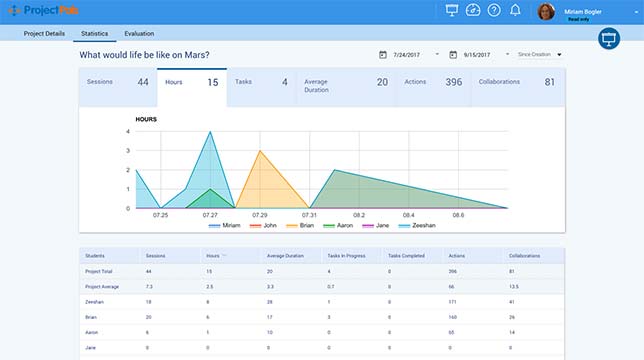
The system, called Project Pals, aims to provide a space in which students can collaborate and upload content; but it also includes tools for teachers to manage group projects and analyze aspects of the students' work, such as who contributed what to the project. And it can serve as a showcase for the students' work to their classmates and parents.

As the company explained: "Project Pals streamlines project-based learning (PBL) implementation by providing one shared platform for all phases of a project: students plan, visualize, and collaborate; while teachers monitor, respond, and evaluate. The platform is designed to play a role in a wide range of subject areas, such as research projects, scientific explorations, literacy development, and critical-thinking activities. The goal is for children to become lifelong learners with collaboration skills they need to succeed in the 21st century. By working through problems together and creating solutions, students build and enhance their skills across multiple subject areas."

Features include:

  • The ability for students to upload and share media;
  • Real-time updating for collaborative work;
  • Reusable Common Core-aligned projects;
  • Common Core-aligned assessments;
  • Support for teacher-generated projects;
  • Data and analytics dashboards for teachers; and
  • Support for rubrics.

Three types of licenses are available for Project Pals. A classroom license for up to 20 projects and 50 students is free. A Team license for unlimited students and unlimited projects is available for $500 per teacher per year. And a school/district license supporting unlimited students and projects is available for $10 per student per year.

Further details and access to resources can be found at projectpals.com.

About the Author

David Nagel is the former editorial director of 1105 Media's Education Group and editor-in-chief of THE Journal, STEAM Universe, and Spaces4Learning. A 30-year publishing veteran, Nagel has led or contributed to dozens of technology, art, marketing, media, and business publications.

He can be reached at [email protected]. You can also connect with him on LinkedIn at https://www.linkedin.com/in/davidrnagel/ .


Featured

  • digital graph

    Building Genuinely Data-Informed School Districts

    Schools today generate enormous amounts of data. The difference between collecting it and using it effectively often comes down to quality, access, and context.

  • Neon blue security locks with a single red highlight

    With AI, Cybersecurity Focus Shifts from Finding Flaws to Fixing Them

    For decades, one of cybersecurity's biggest challenges has been finding vulnerabilities before attackers do. A growing number of security professionals now say artificial intelligence is changing that equation, shifting the focus from discovering flaws to fixing them quickly enough to prevent exploitation.

  • Top View Shot in Elementary School Computer Science Classroom

    Education's Top 5 Technology Priorities and the Challenges Standing in the Way

    Cybersecurity ranks as the No. 1 priority for education technology leaders in the United States, according to the latest State of Ed Tech report from CoSN, yet insufficient cybersecurity staffing and the lack of a dedicated budget are key barriers.

  • Engineering team implements digital guardrails on AI

    3 Starting Points for Integrating AI Guardrails in K-12 Districts

    As education leaders start to craft an AI policy that is both practical and flexible enough to evolve with this fast-changing technology, there is at least one principle that should be foundational: AI should serve to augment human critical thinking and creativity but never replace human interaction and decision-making.