Most Districts Still Early in Their Digital Transformation Journey

Digital transformation is still largely in its infancy in K–12 schools and districts.

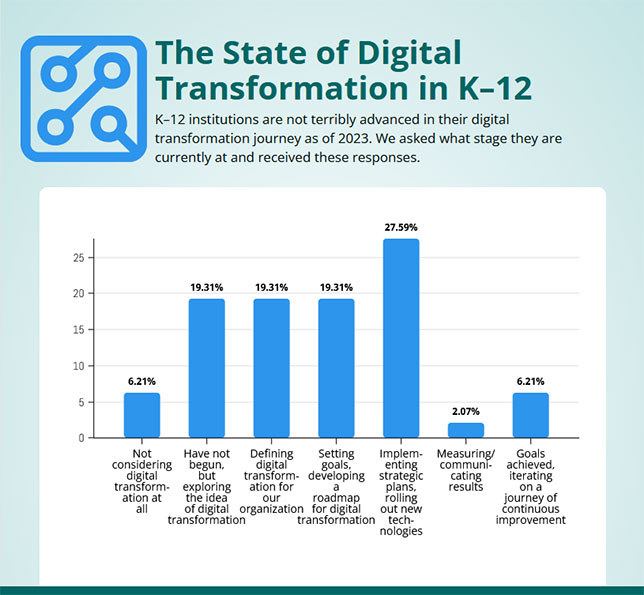
According to the 2023 THE Journal Digital Transformation Survey, nearly two-thirds of respondents said they have not yet begun to implement their strategies or roll out technologies as part of their transformation.

Overall, 6.21% said they are not considering digital transformation at their institution at all, while 19.31% said they have not started but are exploring the idea of digital transformation. Another 19.31% said they are in the process of defining digital transformation for their organizations. And 19.32% also said they are currently setting goals and designing a roadmap for their digital transformation.

In total, about 36% are in some stage of implementation: 27.59% are implementing their strategies and rolling out technologies; 2.07% are measuring results; and 6.21% said their institutions' goals have been achieved and are currently iterating on a journey of continuous improvement.
Digital transformation is still largely in its infancy in K–12 schools and districts.

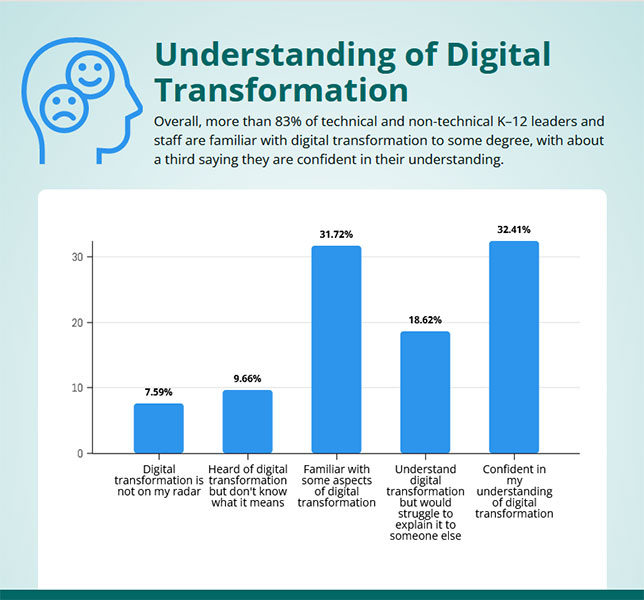
That said, overall, only about a third of respondents (32.41%) overall said they are confident in their understanding of digital transformation. Among non-IT leaders, that figure drops to 16.67%. Among IT leaders, it jumps to 57.89%.

Another 18.62% overall said they understand digital transformation but would struggle to explain it to others. And 31.72% said they are familiar with some aspects of digital transformation.
confidence in understanding of digital transformation

The Digital Transformation Survey was conducted by THE Journal from March 2023 to June 2023 and included 237 responses from schools and districts around the country. Among respondents, 84.39% were from public institutions, with 21.1% at the district level, and the remainder in combined K–12 institutions (15.61%), high school (25.32%), combined secondary (3.38%), middle school (10.13%), elementary school (16.88%), and the remainder in PreK, alternative, or other types of institutions, such as combined K–8.

About the Author

David Nagel is the former editorial director of 1105 Media's Education Group and editor-in-chief of THE Journal, STEAM Universe, and Spaces4Learning. A 30-year publishing veteran, Nagel has led or contributed to dozens of technology, art, marketing, media, and business publications.

He can be reached at [email protected]. You can also connect with him on LinkedIn at https://www.linkedin.com/in/davidrnagel/ .


Featured

  • artificial intelligence on laptop

    OpenAI Plans to Combine AI Products into Desktop 'Superapp'

    OpenAI is reportedly developing a desktop application that would incorporate several of its emerging AI products into a single platform, according to reports, marking the latest step in the company's effort to transform ChatGPT from a standalone chatbot into a broader productivity and automation environment.

  • Engineering team implements digital guardrails on AI

    3 Starting Points for Integrating AI Guardrails in K-12 Districts

    As education leaders start to craft an AI policy that is both practical and flexible enough to evolve with this fast-changing technology, there is at least one principle that should be foundational: AI should serve to augment human critical thinking and creativity but never replace human interaction and decision-making.

  • abstract smartphone translucent screen displaying AI interface

    Apple Unveils Redesigned Siri AI

    At its recent Worldwide Developers Conference, Apple announced Siri AI, a redesigned version of its voice assistant that Apple describes in its own announcement as "a profoundly more capable and personal assistant." The update is intended to make Siri more conversational, more context-aware, and more useful across iPhone, iPad, Mac, Apple Watch, and Vision Pro.

  • circuit patterns

    Anthropic Intros Lower-Cost Claude Sonnet 5

    Anthropic has launched Claude Sonnet 5, positioning the model as its most autonomous mid-tier offering to date and a lower-cost alternative to its flagship Opus 4.8 system. The company said the model can plan multi-step tasks, operate tools such as browsers and terminals, and complete agentic work at a level that previously required larger and more expensive models.