Website Ranks K–12 Reading, Math Programs Under ESSA Standards
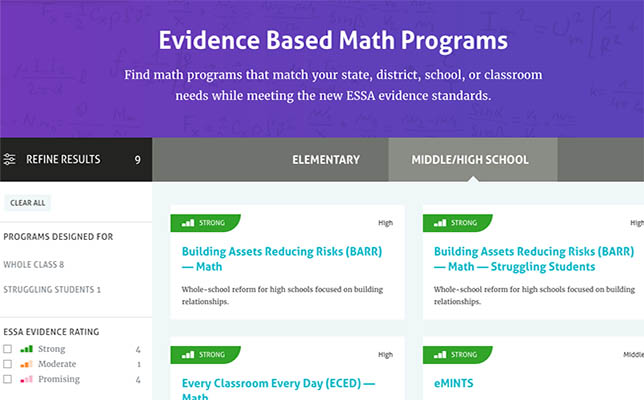
Image Credit: Evidence for ESSA.
A new website launched by the Johns Hopkins University Center for Research and Reform in Education (CRRE) offers insights into K–12 reading and math programs. The website provides up-to-date and reliable information to help education leaders better understand how these programs compare under the Every Student Succeeds Act (ESSA).
The Evidence for ESSA website “uses [the] expertise and authority of the center’s faculty, as well as scholarly studies, to determine an academic program’s effectiveness under the new law,” The Hub reported. It sorts through research databases, locating “school-based, scientific studies and categorizes the programs that have been reliably and scientifically tested.”
Math and reading platforms can be searched by elementary and middle/high school levels. For example, users can look up a math program specifically for the elementary school level to see whether it meets the new ESSA evidence standards. Programs are ranked using language found in the law — either “strong,” “moderate” or “promising,” depending on the quality of their ESSA alignment.
The results can be filtered by:
- Grade level;
- Programs designed for the whole class or struggling students;
- Community type (rural, suburban, urban or not specified);
- Ethnic group; and
- An array of features, including cooperative learning, family engagement and more.
Director of the CRRE and School of Education Professor Robert Slavin told The Hub that the website functions as a consumer report of sorts, with an overall goal of helping state chiefs, district superintendents, principals and other education leaders determine how vigorously a program has been vetted.
"But there are many other people — parents and teachers, for example — who could use this information to advocate for particular programs that they think would be better for their kids. And we hope they will," Slavin said.
The Evidence for ESSA website is now live.
About the Author
Sri Ravipati is Web producer for THE Journal and Campus Technology. She can be reached at [email protected].