Wyoming and New Hampshire Teachers ‘Ramp’ Up STEM Expertise
Teachers completed a 10-day intensive summer program, led by the University of Wyoming, that taught project-based STEM.
A federally-funded grant program created by University of Wyoming (UWyo) faculty that promotes STEM careers has wrapped up its first round of training teachers from various schools across Wyoming and New Hampshire.
RAMPED (robotics, applied mathematics, physics and engineering design) is a professional development program funded by the Wyoming Department of Education, through the U.S. Department of Education’s Math and Science Partnerships grant. The three-year program involves at least 25 teachers each year experiencing a 10-day summer institute that takes place on the UWyo campus. In the spring, the teachers will attend six days of follow-up training in the Natrona County School District (NCSD), a major partner in the program.
For its inaugural year, the program began on July 1 with 18 teachers from NCSD, 10 from other schools in Wyoming and two from New Hampshire. The first week involved projects that used Raspberry Pi, Arduino and Baxter Robot, while the second week involved space, virtual reality and naturally inspired projects. Participants worked directly with physicists, astronomers, mathematicians, computer scientists and computer engineers to complete the projects.
Planning for RAMPED began in the summer of 2015, after NCSD created a strategic plan to increase its graduation rates by working with UWyo instructors.
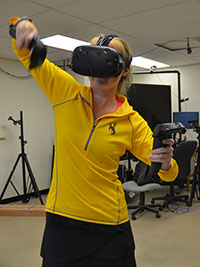
Teachers tested virtual reality equipment through RAMPED. Source: University of Wyoming News.
Andrea Burrows, assistant professor of secondary education at UWyo College of Education, played a central role in creating the program. “RAMPED provides teachers professional development to enable six active-learning projects revolving around robotics, applied mathematics, physics and engineering design,” Burrows said in a news release from UWyo.
Riverton High School physics instructor Ceira Lee was among the 30 teachers who participated in RAMPED. She said the program equipped her with skills to help her students succeed in STEM careers. “These tools will allow me to give more applications to my students for them to better understand the material,” Lee said in a news release. “Plus, having more hands-on activities will give them a better idea of what a professional in that field does.”
To view the curriculum developed by the teachers, or to learn more about the program, visit the RAMPED site.
About the Author
Sri Ravipati is Web producer for THE Journal and Campus Technology. She can be reached at [email protected].