Lifeliqe Piloting Mixed Reality on Microsoft HoloLens for Grade 6-12 Classrooms
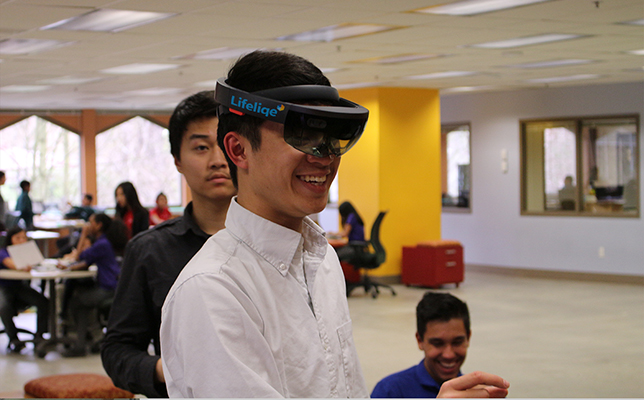
A student at Renton Prep Christian School in Washington state tries out the Lifeliqe mixed reality app on HoloLens.
Using interactive 3D models and lesson plans from its app, Lifeliqe (pronounced “life like”) is now delivering educational content on two major immersive hardware platforms (Microsoft HoloLens and HTC Vive) as well as software platforms (Windows and iOS).
Students and teachers at Renton Prep Christian School in Washington state and Castro Valley Unified College in California participated in the pilot and were the first ever to try out Lifeliqe’s educational content on HoloLens during a science lesson (see video).
“We’ve been using virtual reality as part of education at school for several months,” said Michelle Zimmerman, director of innovative teaching and learning sciences at Renton Prep, in a statement. It “seems that students have preference for mixed reality for learning, but the reason for it will be our next round of investigation.”
Richard Schneck, career specialist at Castro Valley Unified College, said in a statement: “When using Lifeliqe's learning experiences students were excited to dive into the blood vessel because they could visualize it, which should help their memory retention.”
The students used Lifeliqe on HoloLens in lessons on the circulatory system and electronegativity. “I thought it was really realistic and it was really fun to experience,” said Emmy, an eighth grade student from Renton Prep. More students and teachers will be able to experience Lifeliqe on HoloLens as the pilots will be conducted at number of schools in coming weeks, the company said in a news release.
“Mixed reality offers [a] completely unique means to deliver educational content and we are excited to take another step forward in providing immersive learning experiences,” said Ondrej Homola, CEO of Lifeliqe, in a statement. “The excitement we witnessed during the pilot shows us the great potential mixed reality has in sparking lightbulb moments.”
Microsoft is the second major tech company to start cooperating with Lifeliqe on content development, Homola said. In 2016, Lifeliqe was chosen by HTC Vive as a strategic partner for education.
To learn more about Lifeliqe and its educational projects, visit the company’s website.
Lifeliqe, a San Francisco-based visual learning platform incorporating virtual reality (VR), augmented reality (AR), mixed reality and interactive 3D, is piloting mixed reality educational scenarios for Microsoft HoloLens in grade 6-12 classrooms.
About the Author
Richard Chang is associate editor of THE Journal. He can be reached at [email protected].