National Contest Challenges High Schoolers' Virtual Business Moxie
- By Dian Schaffhauser
- 05/10/17
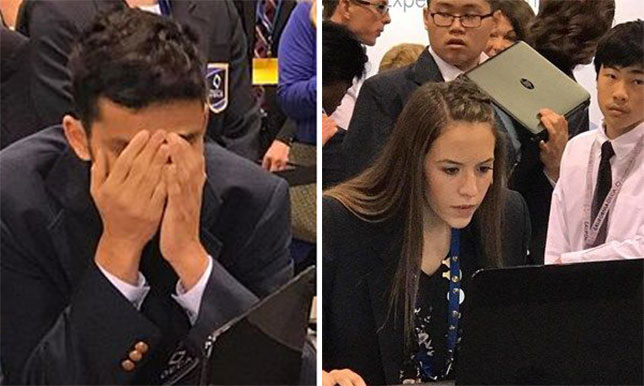
They were bedecked in blazers, ties, business pants and dresses, and they came armed with smarts about accounting, restaurants and retail. By the end, six teams of high schoolers out of 17,000 attendees made the cut and took first place in their respective top categories at this year's virtual business simulation challenge hosted by non-profit student organization DECA International.
DECA's mission is to help prepare "emerging leaders and entrepreneurs" in high school and college for future careers in marketing, finance, hospitality and management. Attending the virtual business simulation competition that took place recently at the Anaheim Convention Center was the goal for 41,357 students who have competed online since last October for a place at the culminating event. The conference also included leadership and business sessions.
Participants that showed up in Southern California took written challenges, performed role-play events and tested real-world business strategies modeled in Virtual Business, a simulation program from Knowledge Matters. For that part of the contest, the idea was to create the most successful business in terms of profit in one of five segments — retail, accounting, sports, hotel and restaurant — or to accumulate the highest personal net worth in a personal finance category.
Along with those awards, recognition was given to students in challenges related to food service operations, automotive services marketing, fashion merchandising promotion, professional selling and dozens of other areas.
For example, among the 45 students from Hartland High School in Michigan in attendance, one team designed a campaign for the "Shinola Detroit Company," intended to highlight Michigan workers, and another team created a social media marketing campaign for a family-owned golf course.
Boris Pattison, a senior at Ohio's Bellefontaine High School won an award for his presentation on the differences and benefits between buying and leasing a vehicle.
All of the students who participated were members of high school DECA chapters.
"In an era when some news headlines about high school students and education can question the quality of the high school educational experience, the Virtual Business Challenge is a prime example of the quality, expertise and dedication of today's high school students," said Peter Jordan, president and CEO of Knowledge Matters, in a prepared statement.
"Each year, we can't wait to see the Virtual Business Challenge unfold," added Paul Wardinski, DECA's executive director. "It's loud and fun to watch as the competitors are cheered on by advisors and classmates as they scramble to quickly earn the most profits with their virtual businesses."
About the Author
Dian Schaffhauser is a former senior contributing editor for 1105 Media's education publications THE Journal, Campus Technology and Spaces4Learning.