Optoma Updates Laser Projector Series with New Ultra-Short-Throw Models

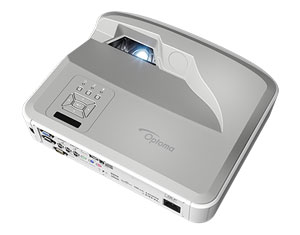
Optoma ZU500UST

Optoma ZU500UST

Optoma has added new models to its laser and lamp projector series, all designed for education.

In the laser series, two new ultra-short-throw projectors are wireless, have 5,000 lumens of brightness and produce images up to 120-inches in size. The new Optoma ZH500UST, which is priced at $3,199, features 1920x1080 resolution. The ZU500UST, priced at $3,299, has 1920x1200 resolution.

Besides having ports for HDMI and VGA connections, the devices are equipped with USB image viewers and office document readers, to allow users to play audio, images and other files without a PC. They also include digital signage mode support and "four-corner adjustment," which allows for quick image adjustment from any corner of the image in situations where the projection surface is angled or uneven. Connected to the campus network, audiovisual administrators can control the projector via telnet and Crestron in managed installations.

The company estimated the light source life at up to 30,000 hours in "eco-mode."

In Optoma's lamp series, the W412 ($619) features 1280x800 WXGA resolution and 4,400 lumens of brightness. It can support 4K UHD HDR input sources. The X412 model ($519) delivers 1024x768 XGA resolution and 4,200 lumens and handles HDMI and VGA inputs. Both lamp projectors feature flexible zoom, keystone correction and RS-232 control. They also have a lamp life estimated at 15,000 hours and 10-watt speakers.

For more information, go to the Optoma site.

About the Author

Dian Schaffhauser is a former senior contributing editor for 1105 Media's education publications THE Journal, Campus Technology and Spaces4Learning.

Featured

  • digital brain integrating legal regulation and security interface

    Survey: Agentic AI Moves from Pilot Phase to Production, Bringing Governance to the Forefront

    A new report from Caylent, an AI-focused Amazon Web Services Premier Tier Services Partner, found that enterprises are already moving agentic AI beyond pilots and into production environments. At the same time, organizations are putting strict conditions around autonomy, making governance and control the next major challenge for enterprise AI adoption.

  • Digital document and folder warning alert with error

    When Cyber Attacks Disrupt Learning, Recovery Matters More than Ever

    As schools become more dependent on digital platforms for instruction, grading, student services, and family communication, resilience depends not only on preventing attacks, but on how quickly leaders can restore trusted data, recover essential services, and keep disruptions from cascading across the school community.

  • Blurred silhouettes of business people in a modern office with a glowing blue network overlay

    Open Secure AI Alliance Moving Under Linux Foundation

    Governance of the Open Secure AI Alliance has moved to the Linux Foundation, giving the initiative what the organizations describe as a neutral home for developing open source tools, shared standards and defensive practices. The Alliance was launched by NVIDIA in July to develop open security technologies for AI systems and agents.

  • Abstract digital hacker man with a laptop

    Cyber Criminals Choosing Shared Prompts, Fraud Kits Over Custom Malicious AI Models

    Increasingly, cyber criminals are sharing AI prompts, jailbreak techniques, and access to existing models that can be incorporated into fraud and phishing operations, according the latest AI Threat Report from Flashpoint.