Annual CoSN Survey Shows Widespread Lack of Professional Learning Support, Budget Restraints Persist
- By Kristal Kuykendall
- 05/25/23
CoSN’s 10th annual State of Ed Tech Leadership report released this week shows some things remain the same — K–12 technology leaders need more resources to keep up with technological innovations in schools — while priorities since the survey began have shifted remarkably.
The report, based on a national survey of over 1,200 school district administrators, illlustrates that districts are modernizing their digital ecosystems, yet the speed at which new technologies emerge combined with the rise in critical cybersecurity threats “have created a K–12 technology environment that is drastically different than 10 years ago,” said the Consortium on School Networking.
“Much has changed since our initial survey in 2013, such as ransomware threats, evolving education network and technologies, and protecting the privacy of student data,” said Keith Krueger, CEO of CoSN. “These new responsibilities put increased demands on ed tech leaders and, unfortunately, districts’ budgets and capacity have not increased proportionally to meet such ever-growing challenges.”
The survey was conducted in partnership with MCH Strategic Data, K12 Insight, CDW Education and AASA, The School Superintendents Association.
Summary of Key Findings from the State of Ed Tech Report
-
The biggest challenge for ed tech leaders remains budget constraints and lack of resources, according to respondents.
-
Top priorities have changed significantly: The top three in 2013 were mobile learning, BYOD (bring your own device) and online assessment readiness. This year, cybersecurity tops the list, followed by network infrastructure, data privacy and security.
-
Only a third of IT leaders feel their district has sufficient resources to deal with cybersecurity issues.
-
12% of districts surveyed don’t allocate any funds for cybersecurity defense.
-
Two-thirds of districts do not have a full-time cybersecurity position.
-
VOIP has reached nearly all of K–12 schools, with 95% of respondents having implemented it today as compared to 55% in 2013.
-
Students are less likely to receive support for off-campus broadband access than in 2021. During the height of remote learning, 95% of districts were providing off-campus broadband compared to 74% of districts this year.
CoSN also released its first Ed Tech Salary Report, available for CoSN members.
Key Findings: Demographics, Staffing, Budgets
-
The percentage of ed tech leaders earning $130,000 or more has tripled over 10 years, from 6% in 2013 to 18% today.
-
Overall, men tend to earn more than women: Nearly half (49%) of male ed tech leaders earn $100,000 or more compared to 37% of women.
-
About one-third of ed tech leaders are female, and two-thirds are male.
-
More ed tech leaders now report coming from an education/instruction background: 55% of respondents in 2023 compared to 45% in 2013.
-
Two-thirds of districts surveyed said they do not have a full-time cybersecurity position.
-
40% said they do not have an Instructional Technology Coach
-
38% reported that their district lacks a “top Instructional Technology Leader.”
-
25% of districts do not have a “top System Administrator” position.
-
63% of K–12 districts’ technology budgets account for 5% or less of the district’s total budget, including 20% of districts that allot less than 2%. Respondents’ tech budgets in proportion to district budgets range from less than 2% to a few reporting more than 15% — a broad range indicating “there is not a reliable formula for determining the right IT budget allocation,” CoSN said.
Key Findings: Keeping Up With New Tech
-
The lack of school system support for professional learning is apparent in the responses to the question, “How does your IT department receive its professional development?” CoSN’s report said.
-
Only 33% of school systems provide in-person training, and just 28% provide online training.
-
Most IT departments stay up to date on their own, with 78% saying they are self-taught.
-
76% of respondents said they rely on an organization’s professional development resources online and 56% in person.
-
58% of respondents said they leverage vendors’ online resources and 41% taking advantage of vendor in-person training offerings.
-
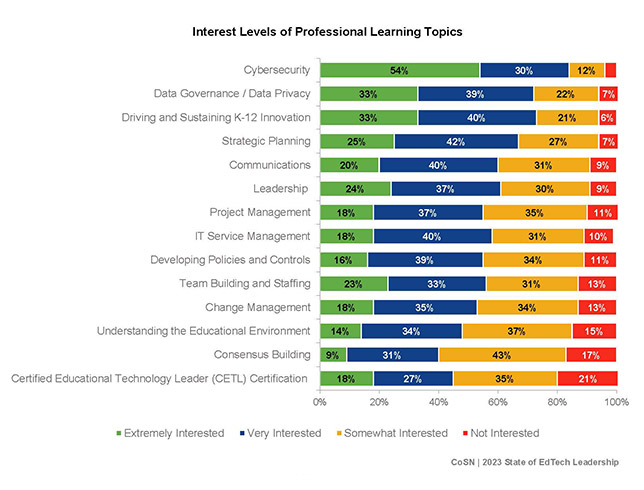
When asked to indicate their degree of interest in various professional learning opportunities, respondents overwhelmingly were most interested in cybersecurity learning opportunities, at 84%.
-
73% said they were extremely or very interested in learning about driving and sustaining K–12 innovation.
-
72% of respondents said they were extremely or very interested in data governance/ data privacy professional learning.
-
The next-ranked topics were strategic planning at 67%, leadership at 61%, and communications at 60%.
“The insights gleaned from this year’s survey are more critical than ever. Notably, the enduring challenge of budget constraints underscores the need for efficient and smart resource utilization in our schools. The increasing importance of cybersecurity and data privacy is another key takeaway that educators and leaders cannot afford to overlook,” said Amy Rambo, president at MCH Strategic Data. “As we navigate the shifting landscapes of ed tech, MCH is committed to providing data-driven solutions that aid in these endeavors. We stand with our education community, determined to turn these insights into action for the benefit of our educators and students.”