New York City Area High School Teams Win Cornell U Programming Contest
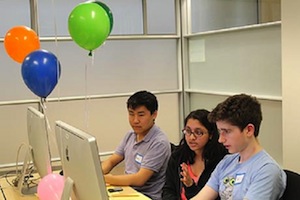 Teams from New York City-area high schools snagged the top spots at the
second
annual Cornell
University High School Programming Contest, in which the
teams were asked to solve problems by writing their own computer
programs.
Teams from New York City-area high schools snagged the top spots at the
second
annual Cornell
University High School Programming Contest, in which the
teams were asked to solve problems by writing their own computer
programs.
That is in contrast to last year's inaugural
competition in
which schools closer to Cornell, in the Ithaca, NY area, took the top
honors.
This year, teams from the Dalton School in New York
City took
first and third place while a team from Byram Hills High School in
Westchester
County, NY took second place. Last year, teams from Ithaca High School
won
first and third place and a team from West Irondequoit High School in
Rochester, NY came in second.
Both years, the goal was for teams to take seven
problems they
were presented with and solve them by writing their own computer
programs. The
problems this year ranged from translating English into Pig Latin to
calculating the grade a student would need on a final exam to pass a
class and
counting the guests at an imaginary party.
Each team was provided only a computer workstation,
pencils,
paper and a calculator. None were allowed access to any other electronic
devices or the Internet. Although the teams could choose almost any
programming
language they wanted, all chose Java, the language typically taught in
high
school.
The winners were those teams that solved the most
problems
within a three-hour period. The problems varied in complexity and, among
the
teams' concerns, was deciding which ones could be solved the quickest.
The "judge" was actually a computer program that
compared the
submitted entries with the expected result.
This year, of the 17 teams from eight schools to
participate, two
teams solved all seven problems, one each solved five or six and three
teams
solved four.
About the Author
Michael Hart is a Los Angeles-based freelance writer and the former executive editor of THE Journal.