Research: Primary School Students Receive Three Times Recommended Homework Load
Students in primary schools are being assigned nearly three times the amount recommended by the National Education Association (NEA), according to
new research appearing in the American
Journal of Family Therapy.
The researchers, led by Robert Pressman, interviewed 1,173 parents with children in grades K-12 using a paper and pencil questionnaire.
Though the NEA recommends students be assigned approximately 10-20 minutes of
homework each night in the first grade and an additional 10 minutes each year, researchers found that students in first and second grades spent
nearly 30 minutes on homework each night on average.
Students in kindergarten, for whom the NEA does not recommend homework, spent an average of 25 minutes each night on school work, according
to the researchers.
"The levels of family stress and tension found in this study fall into ranges that could lead to detrimental physical and mental health,"
said Pressman, in a news release. "The Kindergarten homework load was identical to that of first and second graders. In that period when
children are focused on early stages of socialization and finessing motor skills, an overload of homework will likely interfere with a
Kindergartener's ability to play and participate in extra-curricular activities."
At the other end, students in grade 12 spent just more than 50 minutes per night, on average, doing home work, less than half the 120-minute
homework load recommended by the NEA.
Researchers also found that, though the homework load did tend to increase as students progressed through school, it did not do so at the
recommended rate or uniformly from year to year.
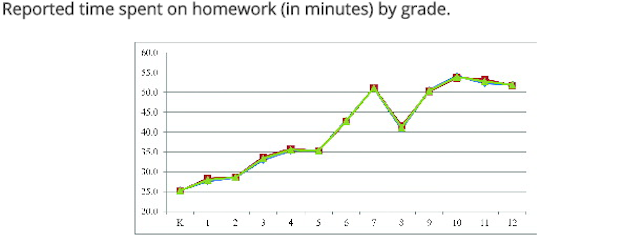
"Overall, the actual homework load increased as students progress from kindergarten until 12th grade, with a significant spike in the 6th
and 7th grades and the largest average amount of time in the 10th grade at 53.9 minutes per night," according to the researchers. "As previous
studies suggested, there is a steady increase in primary school, but not at a rate of 10 minutes per grade."
Other findings of the report include:
- Perceived homework load was similar throughout primary school for parents of all education levels, but diverged in middle school, when
parents who did not graduate high school reported their students spent an average of about 26 minutes per night on homework compared to parents
with some college, who reported their students spent an average of nearly 83 minutes each night on homework;
- The perceived homework load diverges sharply again in grade 11, when parents with a college degree reported their students averaged nearly
98 minutes of homework each night and high school graduates told researchers their students were only averaging 33 minutes of nightly homework;
and
- Conflict associated with homework increased as much as 200 percent in families where the parents did not hold a college degree.
More information is available at
tandfonline.com.
About the Author
Joshua Bolkan is contributing editor for Campus Technology, THE Journal and STEAM Universe. He can be reached at [email protected].