Ricoh Honors Sustainability Efforts with Scholarships
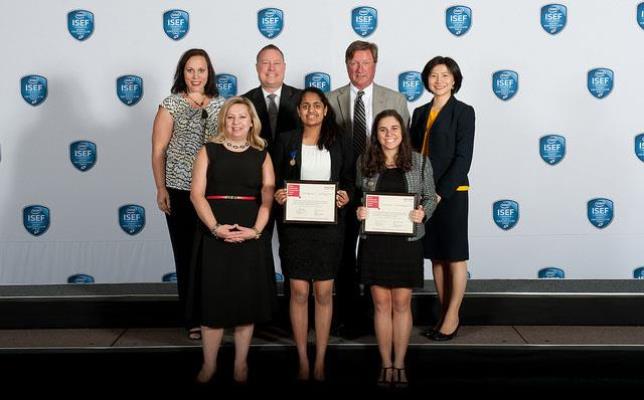
Holding scholarship certificates above are Megha Vyakaranam, center, and Alexis D'Aleessandro, right.
Alexis D’Alessandro of Half Hollow Hills High School West in New York and Megha Vyakaranam of Independence High School in Texas have won Ricoh’s 12th annual Sustainable Development Awards at the Intel International Science and Engineering Fair (ISEF) 2016. Their combined prize was $25,000 in scholarships.
The award program honors students who develop innovations that strengthen environmental sustainability.
D’Alessandro developed a solar powered, permeate gap membrane distillation (PGMD) system for water purification in the Turkana Basin of Kenya. Vyakaranam described her project as “a super soaker for greenhouse gas,” providing a cost-effective method of carbon capture and storage.
“Every year we see talented, hardworking students use their creativity and skills to develop innovative and practical solutions that tackle the global environmental, social and economic issues facing sustainability, demonstrating that a sustainable future can be achieved,” said John Brophy, vice president of product marketing for Ricoh, in a prepared statement. “Ricoh is proud to support these young innovators in their future endeavors with collaborative educational technologies and solutions that help bring their visions to life and to further inspire an environmentally sustainable world.”
In the 12 years since the award’s inception, Ricoh has given more than $400,000 in scholarships to 30 students nationwide.
Ricoh, a Tokyo-headquartered technology company that makes printers, projectors, digital cameras and many other products, upholds four pillars of sustainable environmental management: energy conservation, resource conservation and recycling, pollution prevention and biodiversity conservation. To learn more about Ricoh’s sustainability initiatives, as well as ways to “go green,” visit the company’s website.
About the Author
Richard Chang is associate editor of THE Journal. He can be reached at [email protected].