4 Resources on Coronavirus for K–12 Schools
- By Dian Schaffhauser
- 03/03/20

Source: Centers for
Disease Control and Prevention
Nine projects listed
in DonorsChoose
are currently asking for donations by teachers who want to educate
their students or minimize the threat of Coronavirus, now referred to
by experts more commonly as COVID-19. A teacher in Paterson
Public Elementary School in New Jersey is asking for
the funds to buy "sanitizing wipes, disinfectant spray, alcohol
and peroxide and cleaning supplies in order to stay germ-free and
healthy," for her middle schoolers. Another teacher in Cotter,
AR hopes to acquire games for a "medical
detectives class," which is exploring an "outbreak that is
slowly occurring." The final project, he wrote, "requires
becoming an epidemiologist and learning how to track down the source
to prevent its spread."
Those seem to be the
two options that are most needed right now, as COVID-19 enters the
mainstream — keeping surfaces clean and our hands washed and making
sure we're educated on how viruses operate and what their impact can
be.
But if you're
seeking useful resources for educating your students about COVID-19,
here are four resources we recommend, ordered by youngest learner to
oldest.
A three-minute
podcast (with accompanying transcript) from the
University of Utah Health, an academic healthcare system, offers
multiple tips for teaching young kids how to wash their hands. If you
want to teach them how viruses spread, Dr. Cindy Geller suggest
putting a little glitter on their hands and then letting them off and
play. When they're done, explore the room to see where all the
glitter has landed — other than on their hands.
Recently, NPR
Education published a useful comic guide for kids on
how to protect themselves. While the guide can be read on a device,
it
can also be printed out, folded up, snipped and turned
into a tiny zine.
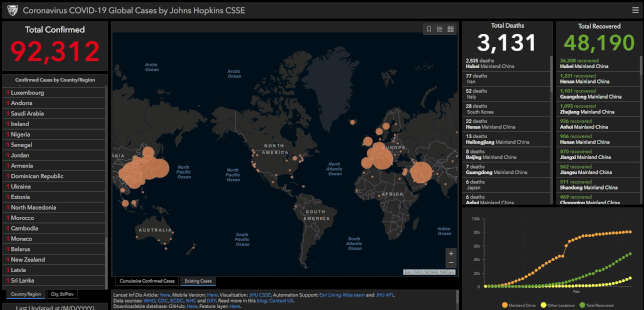
High schoolers may
be interested in monitoring the data updated in real-time on a Johns
Hopkins University interactive dashboard. The
information covers the total confirmed cases of COVID-19; a running
count of total deaths and total recovered (3,131 and 48,190,
respectively, in today's count); the number of cases by country (so
far, that covers 76 named countries, including 106 cases in the
United States); and other related statistics.
Finally, here's a
bonus resource. If you or your students are really serious about
learning about COVID-19, there's a free eight-week Coursera
crash course online whose materials are continually
being updated to reflect the latest information. It's being taught by
three faculty members from Imperial College London's School of Public
Health. Sessions are brief (most are under an hour apiece), and
there's no homework due. Assignments consist of watching short videos
and doing readings. The lessons discuss the details of the virus as
they're currently understood; examine the case fatality rate, how it
varies and why it matters; the "economics" of outbreaks;
how vaccines are developed in real-time; and how the community
participates and the role social media plays.
The Centers for
Disease Control has suggested that schools reach out to their local
public health departments and most have probably already done so.
These health officials are getting continual briefings through
webinars and phone calls from the CDC. But the bulk of the guidance
consists of this for the communities where cases of the virus haven't
been identified: "encouraging hand hygiene, monitoring
absenteeism [and] communicating routinely." In places that have
had confirmed cases, it's trickier. Districts have closed schools
long enough to do a deep-clean; they've taken steps to cancel extra
activities and large events and discouraged the school community from
"gathering or socializing anywhere." Some have even gone to
the extent of helping teachers to prepare to teach online.
Have
COVID-19-related procedures worth sharing? Add them to comments below
so the whole community benefits.
About the Author
Dian Schaffhauser is a former senior contributing editor for 1105 Media's education publications THE Journal, Campus Technology and Spaces4Learning.