Over 70% of Schools Say Pandemic Effect on Student Behavior, Socio-Emotional Development, Staffing Grew Worse in 2021–22
- By Kristal Kuykendall
- 07/07/22
The National Center for Education Statistics’ May 2022 School Pulse Panel survey of U.S. public K–12 schools shows that the COVID-19 pandemic continued to significantly impair student socio-emotional development and behavioral development during the most recent school year, and over half reported that chronic absenteeism was worse than the year before, according to the results released this week.
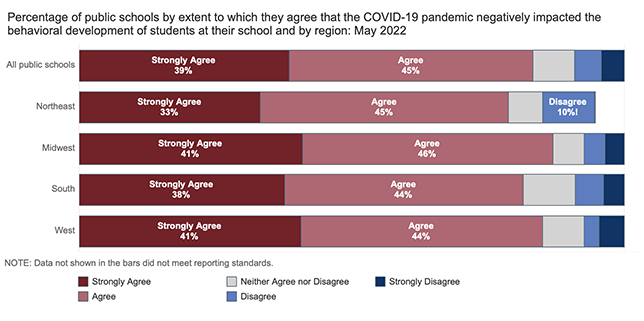
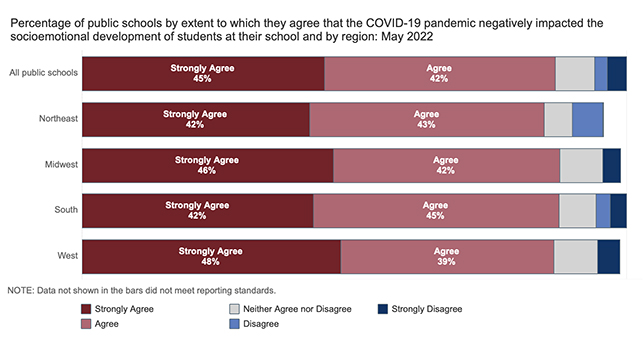
Among the 846 principals who participated in the survey, 87% reported the pandemic negatively impacted socio-emotional development during the 2021–22 school year, and 83% said students’ behavior was negatively impacted.
The School Pulse Panel is conducted monthly by NCES, the statistics division of the U.S. Department of Education Institute for Education Sciences; the May survey focused on staffing, learning modes, student and staff mental health, absenteeism, and classroom management, as reported between May 10 and May 24, 2022, the agency said.
Key Findings: Lingering Pandemic Effects on Students
- 56% of respondents reported increased incidents of classroom disruptions from student misconduct attributed to the lingering effects of the pandemic.
- 49% reported rowdiness outside of the classroom.
- 48% reported “acts of disrespect towards teachers and staff.”
- 72% of all respondents reported an increase in chronic absenteeism (missing at least 10% of the school year) among students, with more than half of those saying that chronic absenteeism increased in 2021–22 over the previous school year.
- The average proportion of the student body considered chronically absent during 2021–22 was 17%, according to the survey results.
- 75% of respondents representing elementary schools reported increased student absenteeism as a pandemic-related problem.
- 73% of respondents representing schools with lower student poverty rates reported increased student absenteeism.
- 71% of respondents representing rural schools reported increased student absenteeism.
Key Findings: Teachers and Staffing
- 77% of respondents reported that finding substitute teachers has become more difficult during the pandemic — 16 percentage points higher than the same survey question results a year prior.
- 72% of U.S. public schools reported an increase in teacher absences during the 2021–22 school year, compared to a typical year pre-pandemic.
- 49% of public schools reported that the rate of teacher absences had increased from the previous school year.
- 99% of respondents reported not being able to always find substitute teachers when necessary.
- In such cases, 74% said they relied on administrators to cover classes.
- 71% relied on non-teaching staff.
- 68% relied on other teachers on their prep period.
- 51% reported combining separate classes into one room when they cannot find a substitute.
- 59% of public schools reported "always" or "very frequently" having to use these strategies during the 2021–22 school year.
Key Findings: Mental Health & Response Strategies
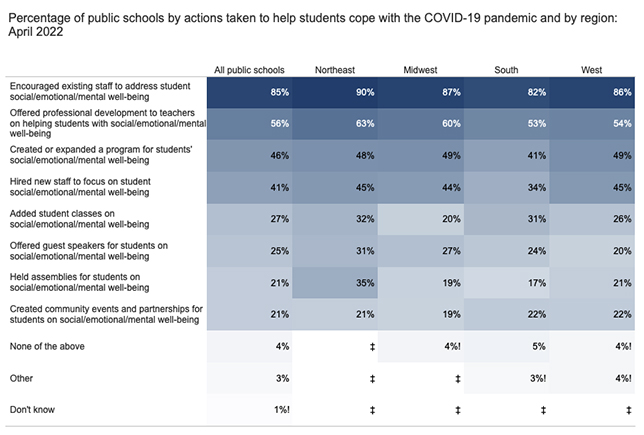
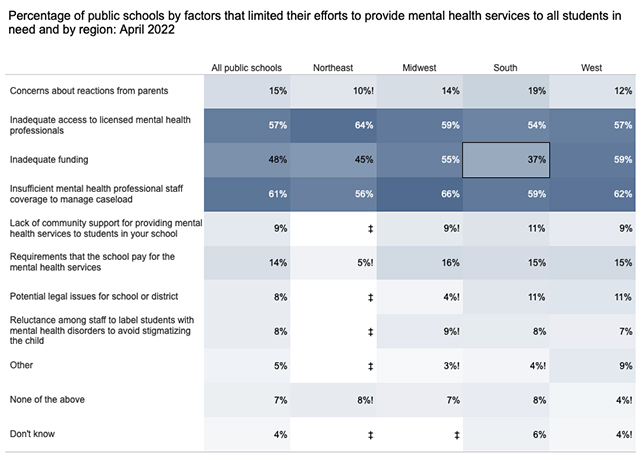
- 79% reported needing more support for student and/or staff mental health.
- 70% reported needing more training on supporting students' socio-emotional development.
- 60% reported needing to hire more staff.
- 51% reported needing training on classroom management strategies.
Key Findings: Learning Modes and Quarantine Prevalence
- 99% of respondents said they continued to offer full-time in-person learning in 2021–22.
- 33% offered full-time remote learning.
- 9% offered hybrid learning.
- 47% of respondents reported having at least one student in quarantine in May, compared to 30% the month prior. The average number of students in quarantine in May was 8, also up from the month before (6).
- 35% reported having at least one staff member in quarantine in May, more than double the 15% reported in April.
Read the full survey report and view results by region, demographics, school size, school level, and poverty classification at https://ies.ed.gov/schoolsurvey/.
About the Author
Kristal Kuykendall is editor, 1105 Media Education Group. She can
be reached at [email protected].