LittleBits Opens Up Access to Kits in Educational Settings
LittleBits,
the four-year-old maker of kits that
allow children and adults to create inventions with a platform of
electronic
building blocks, is launching LittleBits
Education to enhance the use of its
products for schools and libraries.
Since
2011, the company has been making and
distributing pre-made kits that can help children make gadgets like
musical
instruments and robotic cars.
A
Base Kit, which retails online for $99, is designed to help
students learn the basics of electronics and the principals of science,
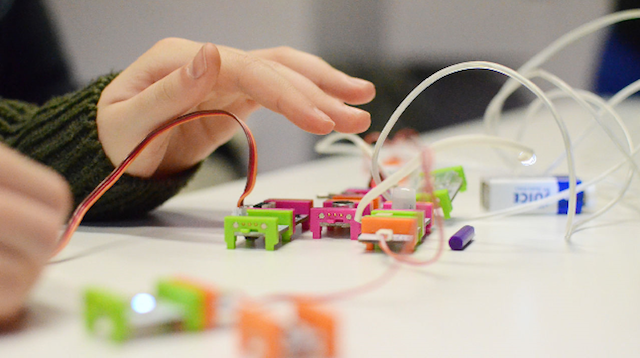
technology, engineering, art and math (STEAM). The kit comes with 10
modules
like a DC motor, buzzer, dimmer and light sensor (and more can be
ordered); an
instruction book with eight projects and access to more online; and
150,000
possible circuit combinations.
In
order to make LittleBits kits more accessible
in the classroom, the company has released four new products:
- LittleBits
STEAM PD, a stand-alone professional
development program designed to help teachers integrate STEAM
instruction into
the classroom;
- LittleBits
Invention Lab, a bundle of products to
be used in libraries and other environments that will allow access to
up to 72
students at one time;
- LittleBits
Classroom Integration, for schools
that want to integrate LittleBits and a STEAM curriculum into multiple
classrooms at once; and
- LittleBits
1:1, a collection of products that
will provide every student with his or her own mobile makerspace.
"We
launched LittleBits Education because we
wanted to make it easy for educational institutions everywhere to find
a way to
bring more 21st-century learning to their
students," said LittleBits
Founder and CEO Ayah Bdeir.
Marymount
School of New York, a private girls
school in New York City, is the first institution to take advantage of
the 1:1
portable invention kits.
"Giving
every girl her own mobile makerspace of
LittleBits offers them opportunities for rapid prototyping their
innovations
and inventions," said Marymount Headmistress Concepcion Alvar.
About the Author
Michael Hart is a Los Angeles-based freelance writer and the former executive editor of THE Journal.