Parents Say Tech is Mostly Good; the Count is Out on Social Networking
- By Dian Schaffhauser
- 11/18/15
Parents worry more about maintaining their kids' privacy of personal information than they do about their children's performance in school, social relationships, health, technology use or behavior. In a list of parental concerns, only personal safety of the child ranked higher than privacy (75 percent vs. 67 percent). The concerns about privacy grow as the child gets older; whereas 61 percent of parents with a child six to nine are concerned, that rises to 72 percent among parents of 14- to 17-year olds.
Yet, among those families whose children have access to technology, only four in 10 parents have turned off the location setting (40 percent) or the data (37 percent) on the child's mobile device. Two thirds (62 percent) of parents of device-equipped children have required that they be accepted as a friend or follower on the child's social network sites.
Those results surfaced in a survey performed for the Family Online Safety Institute, an organization of corporations such as Disney, Microsoft, Google, Verizon, Twitter, Facebook and AT&T that have a stake in the digital practices of their customers. This fall, a research firm hired by the institute surveyed 589 parents of kids aged six to 17 who access the Internet. It also held three focus group in Pennsylvania, each focused on a different age range. The objective was to explore how parents view the role technology plays in their child's life, how informed they feel about what their children do online and how they oversee their child's use of online technology.
Overall, the researchers found, most parents consider tech to have a positive impact on their children's future, career and life skills (78 percent) and creativity (64 percent). Almost every respondent (98 percent) said their child's use of technology had a positive effect on their technology skills. Nearly nine in 10 (89 percent) cited the value of the child's ability to research and find information.
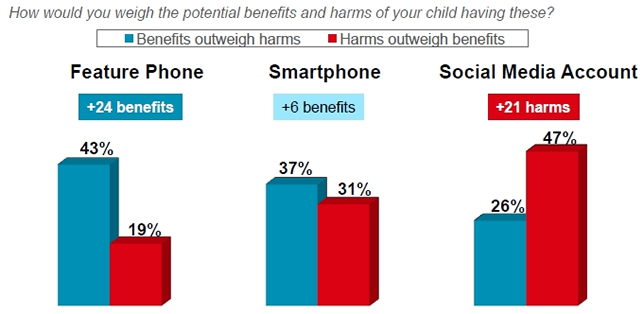
However, that sentiment varies depending on how the tech is being used. For example, nearly half of all parents in the survey (47 percent) said that the harm of social media outweighs the benefits; one in four parents (26 percent) said just the opposite; a similar number (27 percent) said the harms and benefits are just about equal. Among parents whose child has a social networking account, they reported that the account was opened around age 11.7 on average; among those whose children aren't on social networking, they expect to allow it at around age 14.2.
Whereas among all parents 59 percent said they feel confident in their ability to keep track of and manage their children's use of technology, that dipped to 49 percent among parents of girls aged 12 to 17.
And if you've ever confiscated a device as a consequence of a child's behavior, know that you are not alone. Three in four parents have done the same, according to the research.
The report, "Parents, Privacy & Technology Use" is available along with a summary and a presentation on the Family Online Safety Institute's site.
About the Author
Dian Schaffhauser is a former senior contributing editor for 1105 Media's education publications THE Journal, Campus Technology and Spaces4Learning.