Technology + Online + Industry + Partnerships
Computer Science Courses Show Steep Decline
Fewer schools are offering CS classes, which means fewer students
are taking them. One expert calls the trend 'a serious warning sign.'
 According to new research from the Computer
Science Teachers Association (CSTA), the number of advanced
placement computer science courses offered in
high schools has dropped significantly in the last
four years and so have the number of students
enrolled in them.
According to new research from the Computer
Science Teachers Association (CSTA), the number of advanced
placement computer science courses offered in
high schools has dropped significantly in the last
four years and so have the number of students
enrolled in them.
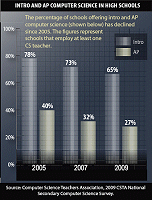
The 2009 CSTA National Secondary Computer
Science Survey, conducted this past
spring, collected responses from some 1,100
high school computer science teachers. Of
those respondents, only 65 percent reported
that their schools offer introductory or pre-AP
computer science classes, compared to 73 percent
in 2007 and 78 percent in 2005. Only 27
percent reported that their schools offer AP
computer science, compared to 32 percent in
2007 and 40 percent in 2005. And among
schools that do provide computer science
courses, a full 70 percent of respondents said
there are qualified students who are not
enrolling in those course offerings.
The survey also asked participants whether
their schools offered CS content in courses
other than introductory or AP computer science
classes. Seventy-four percent answered yes,
down from 85 percent in 2007.
"The continuing drop in students
taking AP CS is a serious warning sign
about the state of computing in this
country, as a student taking AP typically
indicates his or her interest in majoring
in that field in college or pursuing a
career in that area," said Chris Stephenson,
CSTA executive director, in a
statement. "Our innovation economy
requires that students take an interest in
computing, but a host of factors point
in the other direction."
So what challenges have led to the
decline of computer science in K-12?
Survey takers cited lack of teacher subject
knowledge, lack of student subject
knowledge, difficult subject matter, lack
of student interest, and lack of hardware
and software resources. But the top
three reasons cited for the decline were,
in order, rapidly changing technology,
lack of staff support or interest, and lack
of curriculum resources.
Complete results from the 2009 CSTA
National Secondary Computer Science
Survey, as well as comparative results from previous
surveys, can be found here. To read this
article in its entirety, visit here
Green Spot
STUDENTS TO TAKE ON CHALLENGE TO CHANGE THE WORLD
For the second straight year, the
Siemens Foundation, Discovery
Education, and the National
Science Teachers Association
(NSTA are asking
students to help save the planet
through the Siemens We Can
Change the World Challenge.
Elementary school students are
now welcome to compete in the
sustainability challenge, which
last year was open only to middle
school students.
For the 2009-2010 challenge,
teams of students must use webbased
tools to create replicable
solutions to environmental issues
in their classroom (grades K to 2),
school (3 to 5), and community
(6 to 8). A panel of environmental
experts and science teachers will
select state finalists and grandprize
winners to receive prizes
that vary according to grade
level, and include savings bonds,
school grants, trips, TV appearances,
and more.
The contest kicked off in
August during the United Nations
International Youth Day in New
York City, where last year's grandprize
winner, Team Dead Weight
from West Branch Middle School (IA), presented its project to
peers and UN representatives.
The entry deadline for elementary
school students is Jan. 31, 2010;
middle school entries will be
accepted until March 15. To learn
more about this year's contest,
visit here.
:: Industry News
AVERMEDIA ANNOUNCES STIMULUS
PROMOTION. Through Sept. 30, presentation
and surveillance technology
provider Avermedia will be offering a "buy eight, get
one free" stimulus promotion for the
Avervision CP300 interactive document
camera. The company is presenting
the offer as a way to help schools and
districts maximize stimulus funding by
equipping more classrooms with interactive
visual products. For more information
on how to take advantage of this
promotion, visit here.
 IQ ACADEMY LAUNCHES ONLINE CA
SCHOOL. A new online middle and high
school run by IQ Academy has opened in California.
The school is open to all students in
grades 6 through 12 who live in Los
Angeles County and surrounding coun- ties, including Kern, Orange, San
Bernadino, and Ventura. IQ Academy
California-Los Angeles will provide
tuition-free education through online
courses conducted on laptops provided
by the school, allowing students to work
at their own pace and receive individualized
instruction. The school's curriculum
offerings include core subject areas such
as English and math, plus science labs,
foreign language, and advanced placement
courses. Students will have anytime,
anywhere access to courses and assignments,
plus one-on-one feedback from
certified teachers. For more information,
visit here.
IQ ACADEMY LAUNCHES ONLINE CA
SCHOOL. A new online middle and high
school run by IQ Academy has opened in California.
The school is open to all students in
grades 6 through 12 who live in Los
Angeles County and surrounding coun- ties, including Kern, Orange, San
Bernadino, and Ventura. IQ Academy
California-Los Angeles will provide
tuition-free education through online
courses conducted on laptops provided
by the school, allowing students to work
at their own pace and receive individualized
instruction. The school's curriculum
offerings include core subject areas such
as English and math, plus science labs,
foreign language, and advanced placement
courses. Students will have anytime,
anywhere access to courses and assignments,
plus one-on-one feedback from
certified teachers. For more information,
visit here.
VERNIER HOLDS FREE FALL WORKSHOPS.
Starting this month, science
teachers in 41 cities can build their
teaching and tech integration skills at
Vernier Software & Technology's free fall workshops.
The four-hour, hands-on workshops
will concentrate on giving teachers the
skills necessary for integrating data
collection and analysis into teaching
key science topics. Current or former
science and math teachers with extensive
classroom experience will lead the
sessions. For more information about
the workshops, including dates and
locations, visit here.