Groups Urge FBI to Dismantle Website Aimed at Schools
'Don't Be a Puppet' criticized for targeting Muslims and discouraging freedom of speech.
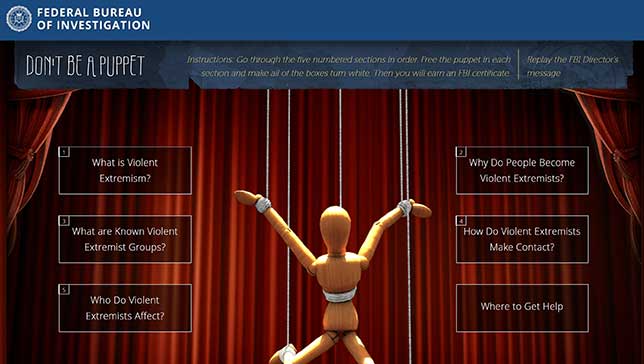
The American Civil Liberties Union, along with the American-Arab Anti-Discrimination Committee and other groups, has formed a coalition to urge the FBI to get rid of its “Don’t Be a Puppet” website. The federal agency created the site to educate youth about violent extremism, but critics have argued that “Don’t Be a Puppet” focuses on American Muslims and discourages students from thinking and expressing their thoughts freely.
“This website will seriously damage trusted relationships between educators and students and cannot be described as a legitimate or credible law enforcement tool,” the coalition stated in a letter sent Tuesday to FBI Director James Comey, according to the Albuquerque Journal.
“The website would have teachers and community leaders ... determine whether views are extremist or radical and report them to police, inappropriately discouraging views protected by the First Amendment,” the letter said.
It continued: “Not only will ‘Don’t Be a Puppet’ hinder the free exchange of speech, ideas, and debate on controversial topics because students are afraid of being labeled suspect and being reported to the police, but it will also isolate students and possibly subject them to bullying.”
The FBI rolled out the website, which functions like a game, in February for utilization in schools to instruct teens about violent extremist groups, both foreign and domestic. The site also strives to prevent visitors from becoming radicalized and recruited by groups such as the Islamic State. “Don’t Be a Puppet” encourages students to report suspicious behavior to teachers or others, including law enforcement.
The initial launch of FBI-created site was delayed last November, due to critiques from Muslim and Arab groups who pre-screened it and expressed concerns that it seemed fixated on Muslim and Islamic threats, without addressing far-right or white-supremacist groups.
In the modified version, visitors click on various subjects, such as “groupthink,” “propaganda” and “distorted principles,” navigate through a messy resistance cell, read attributes of extremist groups and ultimately free a puppet from its strings.
The website is an effort to counter an expanding problem, according to the FBI: the recruitment, especially online, of young people by violent extremist organizations. However, since “Don’t Be a Puppet” went live in February, it has been the subject of increasing criticism and questioning media reports.
The FBI did not comment on the request that the website be taken down, the Journal said. The website does recognize that extremist thoughts are not illegal, and it offers that students should be tolerant and inclusive of all people.
In its letter to the FBI director, the coalition said the website “reinforces the idea that holding views that may be outside the mainstream equates to support for violent extremism,” and that the site reinforces the notion that Muslims are prone to participate in extremist violence.
The coalition also criticized the website’s list of possible warning signs that someone might be planning to commit an act of violent extremism. The list includes “talking about traveling to places that sound suspicious” and “using code words or unusual language.”
In its letter, the coalition said: “A trip to France or Germany, which are home to many far-right groups, is not likely to be considered suspicious by most teachers and community leaders. Although there should be nothing inherently suspicious about traveling either to Saudi Arabia or Iraq, where some Muslim holy sites are located, bias could lead individuals to report innocent, constitutionally protected activity to law enforcement.”
The coalition argued that bias “could easily lead individuals to conclude that speaking foreign languages, such as Arabic, amounts to using ‘unusual language.’”
Along with the ACLU and the American Arab Anti Discrimination Committee, the other groups that signed the letter to the FBI included the Muslim Legal Fund of America, the Friends of Human Rights, the Sikh Coalition, and Teaching Tolerance, a project of the Southern Poverty Law Center.
About the Author
Richard Chang is associate editor of THE Journal. He can be reached at [email protected].