Pluralsight Releases Free Video Programming Courses for Young People
- By Dian Schaffhauser
- 03/26/13
A company that develops video training for software developers has created two online courses specifically for young people. One course from Pluralsight is focused on learning how to program and the other on how to program with Scratch. Pluralsight's catalog has 444 Web courses on topics ranging from Amazon Web Services to XML. Although the adult titles are accessible by subscription, the new ones intended for kids are publicly available for free.
"Teaching Kids Programming" was created by Lynn Langit and Llewellyn Falco, founders of a non-profit organization, Teaching Kids Programming, which has a goal of creating free and open source courseware to help students learn how to program. The video lessons for Pluralsight, they explain in the introduction, are intended not for classroom use but for use by parents who are programmers themselves working with kids one on one.
| | 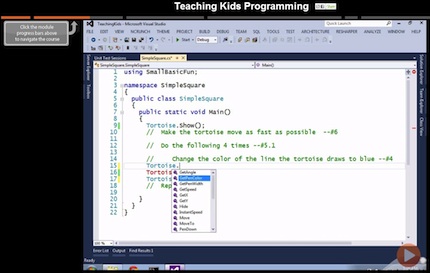
Intended for students 10 and up, "Teaching Kids Programming" features Microsoft Visual Studio and C# in lessons that take just over an hour to complete. | |
Through their own Web site the authors offer a comparable set of lessons using Java and SmallBasic in use by schools. "Kids are taught to consume technology and not to create it. Our goal is to fix that," said Langit. "My partner, Llewellyn, and I firmly believe that programming should be a core skill taught in elementary, middle, and high schools across the globe, which is why we looked to Pluralsight to help us reach worldwide scale with our free courseware for kids."
Although intended for young people aged 10 years and older, said Falco, "If your kids feel comfortable with a keyboard, bring them on." The lessons, which feature Microsoft Visual Studio and C#, last an hour and 14 minutes and are broken into five segments: recipes, recap, variations, quiz, and homework.
"Learning How to Program with Scratch" has four hours and 29 minutes of instruction, presented by Joe Hummel, a visiting professor in the Department of Information and Computer Science at the University of California-Irvine with a specialty in high performance computing and a member of Pluralsight's technical staff. Scratch is a programming language created at MIT specifically for young people to create interactive stories, animations, games, music, and art.
The company said it hopes the videos will spur professional developers--their customer base--to teach programming in their homes and at their local schools.
"As the online education space, a potential trillion dollar segment, and industries upgrade technologies to stay competitive in a global economy, we feel an obligation to provide free educational resources around computer programming that can be incorporated into the school environment and introduced to kids at an early age," said Aaron Skonnard, CEO and co-founder of Pluralsight. "These new experiential courses are easy for parents and instructors to teach, allowing them to track, with each lesson, how kids are progressing."
About the Author
Dian Schaffhauser is a former senior contributing editor for 1105 Media's education publications THE Journal, Campus Technology and Spaces4Learning.