Study: Time Spent with Course Content Isn't Biggest LMS Predictor of Student Success
- By Dian Schaffhauser
- 09/07/16
The biggest predictor of student achievement (based on their use of a learning management system) is not the amount of time they spend working with course content; nor is it how long they spend taking assessments or participating in discussion forums. It's how frequently they check their grades online.
That interesting tidbit comes out of an analysis recently reported by Blackboard on its blog. The LMS company took a sample of data from North American courses in spring 2016 (all anonymized and aggregated at the individual and school level) and filtered it by specific criteria: size of the class (between 10 and 500 students), the average course time (at least 60 minutes) and the use of the gradebook. The filtered results left data on nearly 602,000 learners in almost 19,000 courses.
According to John Whitmer, director for analytics and research at Blackboard, and his co-authors, Nicolas Nunez and Diego Forteza, the "most successful students" are those who access the gradebook function in Blackboard "most frequently." In fact, the researchers found, "students who never access their grades are more likely to fail than students who access them at least once."
The component of the LMS where students spend the most time is course content. The "relationship between time spent accessing content and grade are very clear," the report stated, but only between "no use and some use." After initial access, the link becomes more tenuous. In fact, the authors wrote, "after the median, additional access is related to a decline in student grade." Those students who spend more than the average amount of time with content show declining — not higher — grades. Some of the factors in play here could be that increased access might be the result of students cramming for tests; or the successful students may be filing the online resources offline for later access. The article suggested that faculty consider perusing reports in the LMS that show the percentage of the class that has accessed content, and then send reminders out to students.
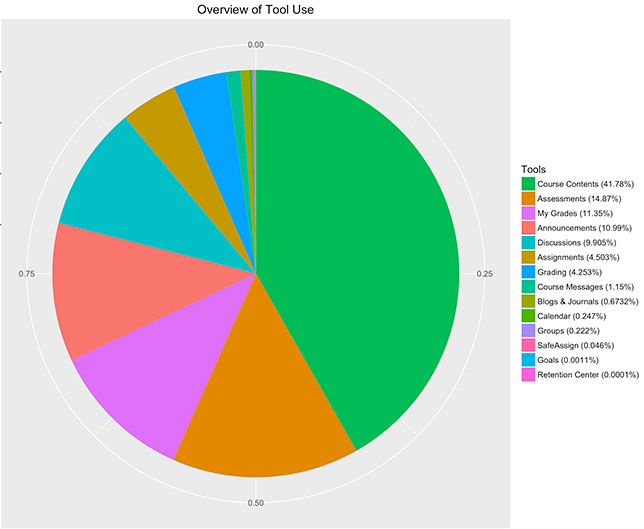
Image courtesy of Blackboard
Details about these and other findings are available on the Blackboard blog.
About the Author
Dian Schaffhauser is a former senior contributing editor for 1105 Media's education publications THE Journal, Campus Technology and Spaces4Learning.