Detroit Makerspace Grows After School STEM Program with $250,000 Google Grant
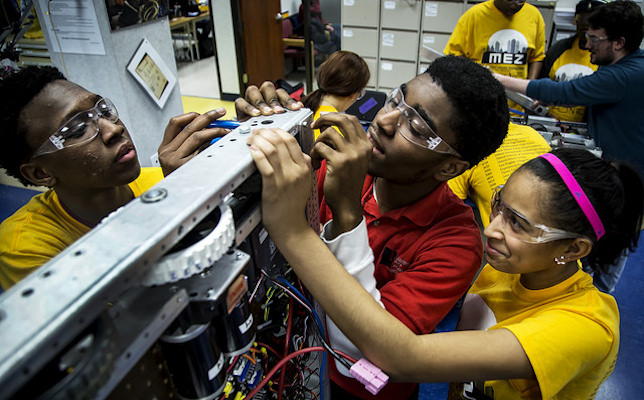
Students learn hands-on at the Michigan Engineering Zone. Image: University of Michigan.

More students in Detroit Public Schools will be participating in after-school programs in science and engineering, thanks to a $250,000 grant from Google to the Michigan Engineering Zone, a makerspace project of the University of Michigan College of Engineering.

The nearly 48,000-student school district is working with the MEZ as well as FIRST Robotics to get hundreds of students interested in pursuing STEM careers. The MEZ provides space, mentorship and tools to students as they build and test robots to compete in the FIRST Robotics competition.

The MEZ just wrapped up its eighth season with 18 high school FIRST teams and more than 275 students from the Detroit area. A majority of participating high school seniors were accepted into two- and four-year colleges and universities and plan to pursue careers in science or technology.

The grant from Google will “allow the program to build the infrastructure to expand by 33 percent to reach a total of 500 students per year,” according to a university statement.

Featured

  • digital lock with circuit patterns

    IBM Adds New AI-Powered Cybersecurity Tools

    IBM has unveiled an expanded portfolio of AI-powered cybersecurity products, positioning the company to compete more aggressively in a rapidly evolving market where enterprises are increasingly turning to artificial intelligence to defend against automated cyber threats.

  • Human Hand Assembling Digital Data Blocks

    Report: AI Impact Starts Relies on Strong Data Foundation

    High-impact AI implementations are more likely to treat data architecture, governance, and operationalization as strategic requirements, according to the 2026 Blueprint report from TDWI.

  • person typing on a touch screen schedule plan calendar

    Deadline Extended for ADA Title II Compliance

    Schools working to meet the Americans with Disabilities Act Title II regulations for digital accessibility have received a temporary reprieve: The United States Department of Justice has published an interim final rule to push back the compliance deadline by one year.

  • AI logo near computer equipment

    White House Issues National Policy Framework for AI

    The White House has released a four-page AI policy framework aimed at setting a national approach to AI, with priorities including child safety, intellectual property protections, truth and accuracy guardrails, and worker training for an AI-driven economy.