Report: Top 5 Vendors in Global AR Education Market
Technavio predicts the worldwide AR in education market will grow at a compound annual growth rate of more than 82 percent by 2021.
Market research firm Technavio has identified the top five vendors in the global augmented reality (AR) in education market. The companies are EON Reality, DAQRI, GAMOOZ, Magic Leap and QuiverVision, according to a newly published report.
Other prominent vendors in the market are expected to be: Meta, Google, Curiscope, Chromville, Aug That, Popar, Blippar and InGage.
Technavio anticipates healthy growth for the global AR in education market, which it predicts will grow at a compound annual growth rate (CAGR) of more than 82 percent by 2021.
Here are some other key market figures, according to Technavio:
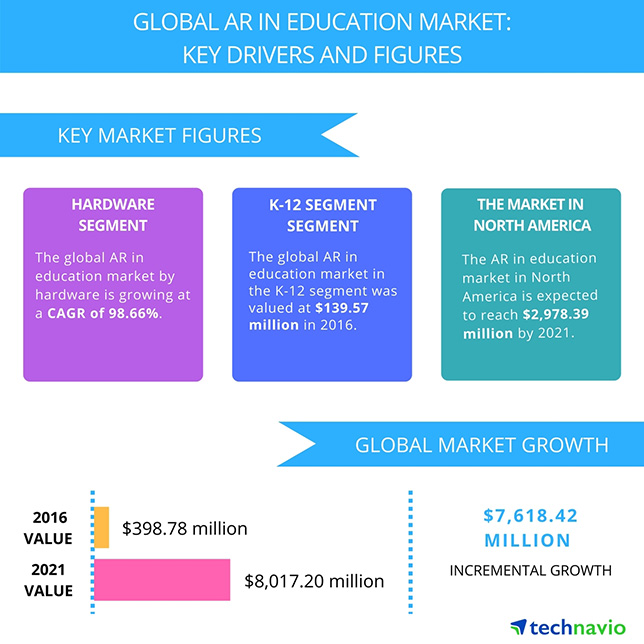
- “The global AR in education market by hardware is growing at a CAGR of 98.66 percent;
- “The global AR in education market in the K–12 segment was valued at $139.57 million in 2016;
- “The AR in education market in North America is expected to reach $2,978.39 million [$2.978 billion] by 2021”;
- The value of the AR in education market in 2016 was $398.78 million;
- The value of the AR in education market is expected to reach $8.017 billion by 2021;
- The incremental growth between 2016 and 2021 is anticipated to soar by $7.6 billion.
“One of the growth factors of the global AR in education market is the demand for student-centric and experiential learning in the education sector,” said Jhansi Mary, a lead analyst at Technavio for ed tech research, in a prepared statement. “The increase in the interest in the development of AR applications and content in the education sector is further catering to the growth of the market. Due to the high price of the HMDs [head mounted displays], the technology is available only to high-end consumers and enterprises. However, vendors are slowly transitioning products to cater to the affordable segment of the market.”
In addition, “the discovery of open source AR applications, which allows teachers and lecturers to create their own basic content, is a huge challenge for the AR vendors catering to the education sector,” according to a news release. “This competition is expected to intensify in the forecast period.”
The report also provides information on the VR in education market, which Technavio expects to grow at a CAGR of more than 55 percent by 2021.
The AR in education report offers an analysis of the market by product type (AR hardware and AR content), by end user (K–12 and higher education) and by geography (Asia Pacific, Europe, North America and the rest of the world).
The 70-page report is available for $2,500 for a single user. To purchase a copy, visit this site. To request a free sample, visit this site.
About the Author
Richard Chang is associate editor of THE Journal. He can be reached at [email protected].