SXSW EDU Featuring the Whimsical and Serious to Spark 'Creative Thinking' in K-12
- By Dian Schaffhauser
- 02/25/19
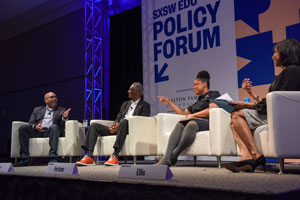
A SXSW EDU 2018 Forum session (Photo by Tico Mendoza)
There may be no better place to combine lofty education issues with a sense of fun and creativity than the SXSW EDU Conference & Festival, coming to Austin next month. Where else can you attend a variety show inspired by student writing projects, participate in a Moth StorySLAM, view a powerful documentary film screening, discuss teaching and learning strategies and debate policy, all in one event?
Two of this year's headliners will share the stage in a discussion about the legacy of U.S. Civil War and its impact on education today. Keynote speaker Paula Kerger heads up PBS, the country's largest non-commercial media organization, with almost 350 member stations. She'll be joined on stage by Harvard Professor and filmmaker Henry Louis Gates, Jr, who also leads the Hutchins Center for African & African American Research at the university. Gates' latest project is the history series "Reconstruction: America after the Civil War," a four-hour documentary that's scheduled to air this spring on PBS. Kerger and Gates will explore how one of the least understood eras in American history — those years following the end of the war — still haunts the country 154 years later. They'll also discuss how educators play a role in examining and teaching its implications.
A number of other eminent speakers will also make appearances during the event, which takes place March 4-7, 2019. The Policy Forum, which highlights policy-oriented sessions, will include an interview between former Florida Gov. Jeb Bush and Washington Post Reporter Laura Meckler on how "disruptive policies" can turn classrooms into ideal "laboratories of learning." Other policy forums will feature:
- Justin Barra from the Chan Zuckerberg Initiative and Seth Gerson from the National Governors Association Education Division discussing new NGA research on what the public might expect from governors over the coming year and the role played by philanthropy in carrying out those visions;
- A panel with current and former Congressional staffers on what might be expected in any rewrite of the Higher Education Act;
- A group of experts, including Future of Privacy Forum's Amelia Vance, discussing how to balance student privacy and security;
- Design professionals talking about how to design safer schools that still make for excellent learning environments;
- An international representation debating why it's important to preserve languages; and
- National experts from K-12 and higher education exploring the impact librarians have on school achievement.
The four-day conference features more than 400 sessions with presentations, workshops, formal mentoring opportunities, panels, films, competitions, an exposition and networking. Many of these have been added to the roster through a "panel picker" process; potential presenters propose their ideas, then the public votes and an advisory board finalizes the list of winners.
Among the more intriguing-sounding events for K-12 educators are these:
The expo will bring together programming, networking and creative spaces to allow attendees to experience hands-on, discovery-based learning activities, along with programming from the NEXT Stage and opportunities for networking in the Meet Up Pavilion.
Lounges, happy hours and parties are being hosted by Google, the Qatar Foundation International, the Hechinger Report, IDEA Public Schools and other organizations and companies.
"Festival programming represents the broad spectrum of experiential and hands-on learning that plays a vital role in education today," said SXSW EDU General Manager Greg Rosenbaum, in statement. "The festival supports the latest creative thinking in how best to support teaching and learning throughout the entire learning cycle."
A badge for access to all of the EDU activities is $595.