Student: Online School Has Helped Prepare Me to Pursue My Dreams of a NASA Career
Often, we think of space as something very far away. After all, Mars, Venus and the other planets are many millions—or even billions—of miles away. Stars are so far away that we measure their distance from us in light-years. Yet, the edge of space, known as the Kármán Line, is just 62 miles above sea level from us.
Now that’s not so far, is it?
Ever since I was little, I’ve wanted to build rockets and work for NASA as an aerospace engineer. While I’ve moved past the idea of launching purple and pink rockets that shoot glitter out into space for all of us to see here on Earth, rockets are something I’m passionate about and something I knew I wanted to help create.
In fact, as a 3-year-old, I told my parents, “I want to build rockets!” My parents have been incredibly supportive throughout my life, and they were that day as well, encouraging me to pursue my passion around rockets. Now, I’m doing just that as I finish up my senior year at Connections Academy here in Wisconsin, an all-virtual public school.
Tailored Lessons and Concepts
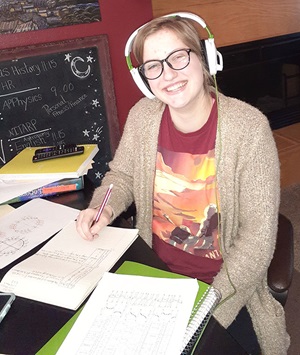 Growing up, I always had a sense of wonder and curiosity about how things work. I like to tinker and construct things. When I was a child, I made model rockets and just recently, I welded a model replica of a Saturn V rocket — one my favorite types of rockets. After all, Apollo 11, the first successful mission to land astronauts on the moon, was a Saturn V rocket.
I continually asked my parents questions about why things work the way they do. “Why, why, why?!” My parents fed that curiosity in me, at least until something new sparked my interest.
In second grade, I enrolled in the Wisconsin Connections Academy. A fully online school seemed like a natural fit for me because of the flexible schedules and the educators who tailored lessons and concepts for me, especially in mathematics.
While I’d always done well in math, I never enjoyed the classes, at least until middle school. I had an exceptional math teacher who loved the subject. He made math fun and connected it to not just the real world, but even rockets. That opened my eyes to the importance of math, and I understood the usefulness and magic of math — to the point where it just clicked after that. Math class became just as fun as science class.
More Time For Rockets and Space Exploration
Although I’m an introvert, I love sharing ideas and talking about rockets and space exploration with others. An all-virtual school allows me more time to focus on becoming an aerospace engineer, actively networking with others in the field and working more closely with other students interested in the same things. You’d think that an online school wouldn’t be as social as a traditional school setting, but for me, the opposite has been true.
Since the eighth grade, I’ve been part of two unique programs. Through IDATA (idataproject.org), I was a co-collaborator on a software program called Afterglow Access, and I was the co-lead author for the Afterglow Access manual. I presented this work at the American Astronomical Society Convention in Honolulu, Hawaii.
In addition, my dad, who is a science teacher, and I participate in NITARP through NASA. NITARP, the NASA/IPAC Teacher Archive Research Program, pairs teachers and students with an astronomer to do real astronomical research. My dad and I have been putting a serious amount of time and effort into the program, and I love every minute! Due to the COVID-19 pandemic, the program kept our team on for a second year and I’ve been making light curves for Active Galactic Nuclei (more or less blackholes).
What’s Next In My Future?
In the fall, I plan to attend the University of Wisconsin-Madison and major in mechanical engineering. Some aerospace engineers choose mechanical engineering as their first major, and I think that’s the best route for me as well. I’m thrilled I was accepted into the program as a freshman, and I know online school set me up for success.
From there, I plan to pursue aerospace engineering through a master’s or even a doctoral program. I’m grateful for my online education — I’ve been extremely lucky to not just connect with passionate teachers that have inspired me, but I’ve also built strong relationships and grown. While we’re just 62 miles from space, I feel like I’m inching closer and closer to my dream.
About the Author
Naleah Boys is a senior at Wisconsin Connections Academy. In the fall of 2022, she will attend the University of Wisconsin-Madison to pursue a major in mechanical engineering, in preparation for her goal of earning a master's or even a Ph.D. in aerospace engineering. Naleah's ultimate goals are to encourage other girls to consider STEM careers — and to be in mission control when the first human steps foot on Mars.