Stop Asking Whether Students Can Use AI
How one district moved beyond "allowed" and "prohibited" to create a shared language for AI-supported learning
- By Dr. Cheri Bridge
- 10/27/26
For the past several years, educators have been trying to answer a deceptively simple question: Should students be allowed to use artificial intelligence for this assignment?
It is an understandable question. It is also becoming the wrong one.
As generative AI has become embedded in the tools students use to search, write, create, translate, organize, and receive feedback, the boundary between "using AI" and "not using AI" has become increasingly difficult to define. More importantly, treating AI use as a binary choice does little to help students understand the different roles AI can appropriately play in learning.
At Zion-Benton Township High School District 126, this realization emerged gradually through three years of AI implementation work. We began exploring AI in 2023, moved into structured pilots in 2025, and expanded our focus to AI literacy and instructional integration in 2026. What started largely as a technology conversation eventually became an instructional one.
We realized that teachers needed something more useful than "AI allowed" or "AI prohibited."
They needed a common language for answering a much more important question: How much AI involvement is appropriate for the learning students are being asked to do?
The Problem With "AI Allowed"
Consider three assignments.
In the first, an English teacher wants to see whether a student can independently construct an argument and support it with evidence.
In the second, students have already developed their arguments but are invited to use AI to generate counterarguments they can analyze and challenge.
In the third, students explicitly study generative AI and are asked to use it extensively, evaluate its output, revise its output, document their process, and defend the decisions they ultimately make.
AI is involved differently in each experience.
Labeling all three simply "AI allowed" obscures those differences. Likewise, prohibiting AI across all three would eliminate opportunities for students to develop the very AI literacy they will need beyond school.
That tension led our AI Advisory Committee to develop a districtwide AI Use Scale.
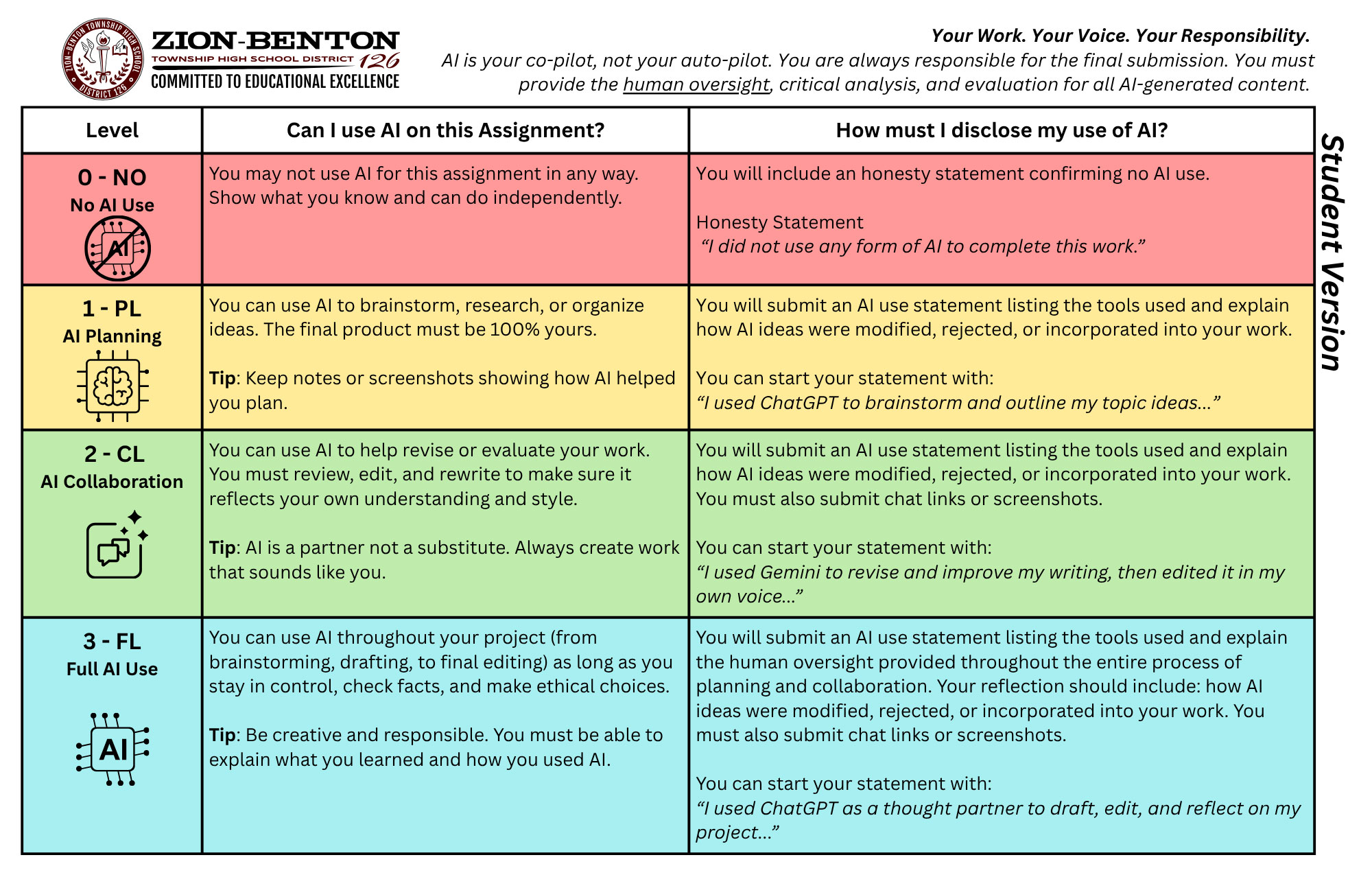 [Click on image for larger view.] AI Use Scale (source: Zion-Benton Township High School District 126).
The scale provides four levels: Level 0: No AI; Level 1: AI Planning; Level 2: AI Collaboration; and Level 3: Full AI Use. It is designed to be displayed in classrooms and referenced by educators so students encounter consistent language across courses and content areas.
The purpose isn't to make AI easier to police. It is to make AI expectations easier to teach.
At Level 0, the learning requires independent student work without AI assistance. At Level 1, AI may support planning and early thinking without becoming responsible for the final product. At Level 2, students may collaborate more substantially with AI while retaining ownership of the learning and final work. At Level 3, extensive AI use is intentionally part of the experience.
That progression gives teachers more precision when designing assignments and gives students something equally valuable: clarity.
Instead of asking, "Can I use ChatGPT on this?" students can begin asking, "What level of AI use is expected here?"
That may sound like a small linguistic shift. Instructionally, it is significant.
The Scale Isn't Enough
As useful as the AI Use Scale proved to be, however, we encountered a deeper problem.
Before teachers can determine how much AI students should use, they have to determine what thinking students are supposed to do.
That realization ultimately led us back to instructional design.
Bloom's Revised Taxonomy remains valuable in our district, but AI has led us to question whether learning in an AI-enabled environment is always best represented by a straightforward hierarchical progression. Students now have tools capable of activating background knowledge, explaining unfamiliar concepts, translating language, providing scaffolds, offering feedback, generating examples, and supporting revision almost instantaneously.
Students can move through those cognitive processes in different sequences and with different levels of support.
Through work involving our Curriculum Committee, Management Team, and AI Advisory Committee, we developed an AI-Supported Personalized Learning Pathways Framework. The model places the learning goal — not artificial intelligence — at its center. Activate (District added "level"), Remember, Understand, Apply, Analyze, Evaluate, and Create surround that goal as interconnected cognitive processes through which learners may move in different ways according to their strengths, experiences, interests, readiness, and instructional needs.
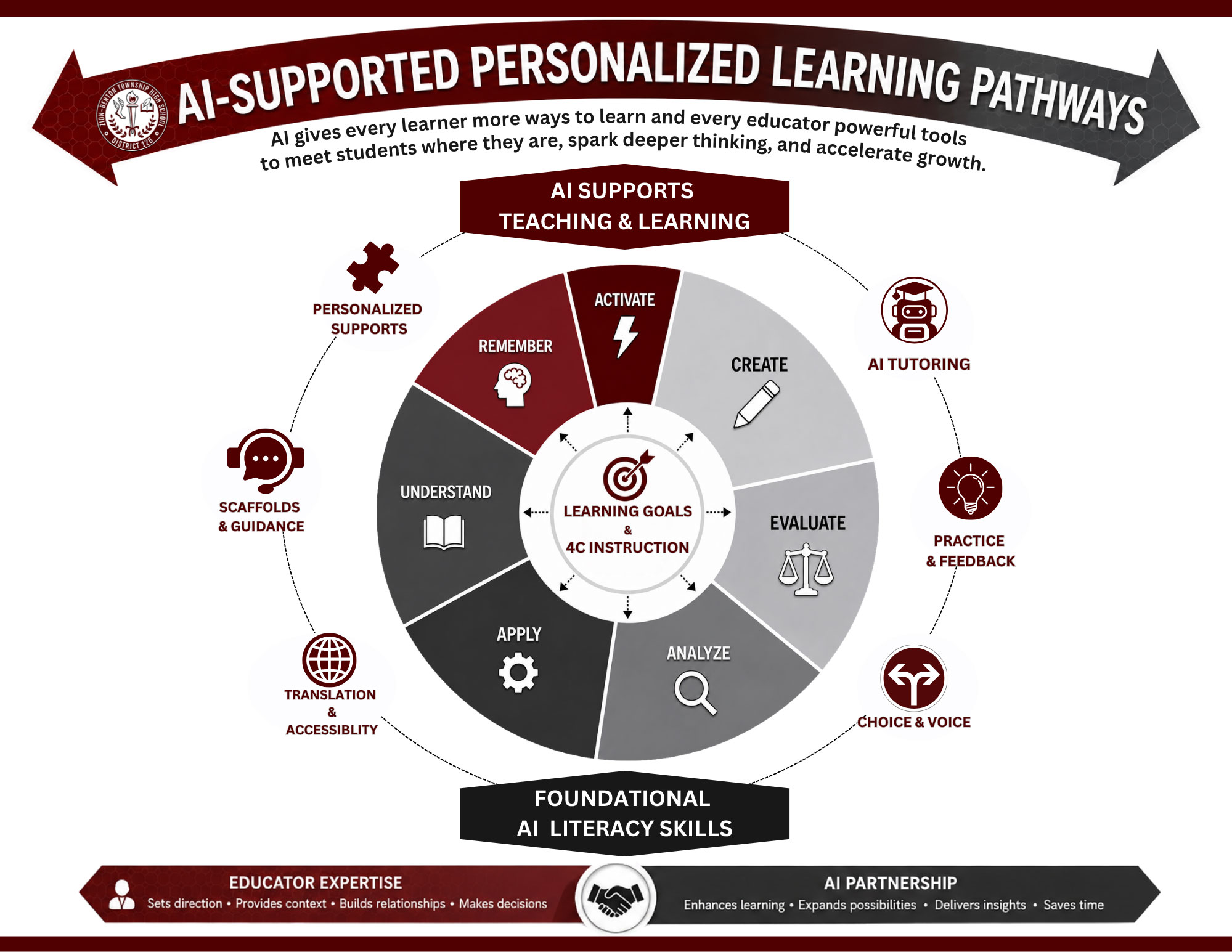 [Click on image for larger view.] AI-Supported Personalized Learning Pathways Framework (Part 1) (source: Zion-Benton Township High School District 126).
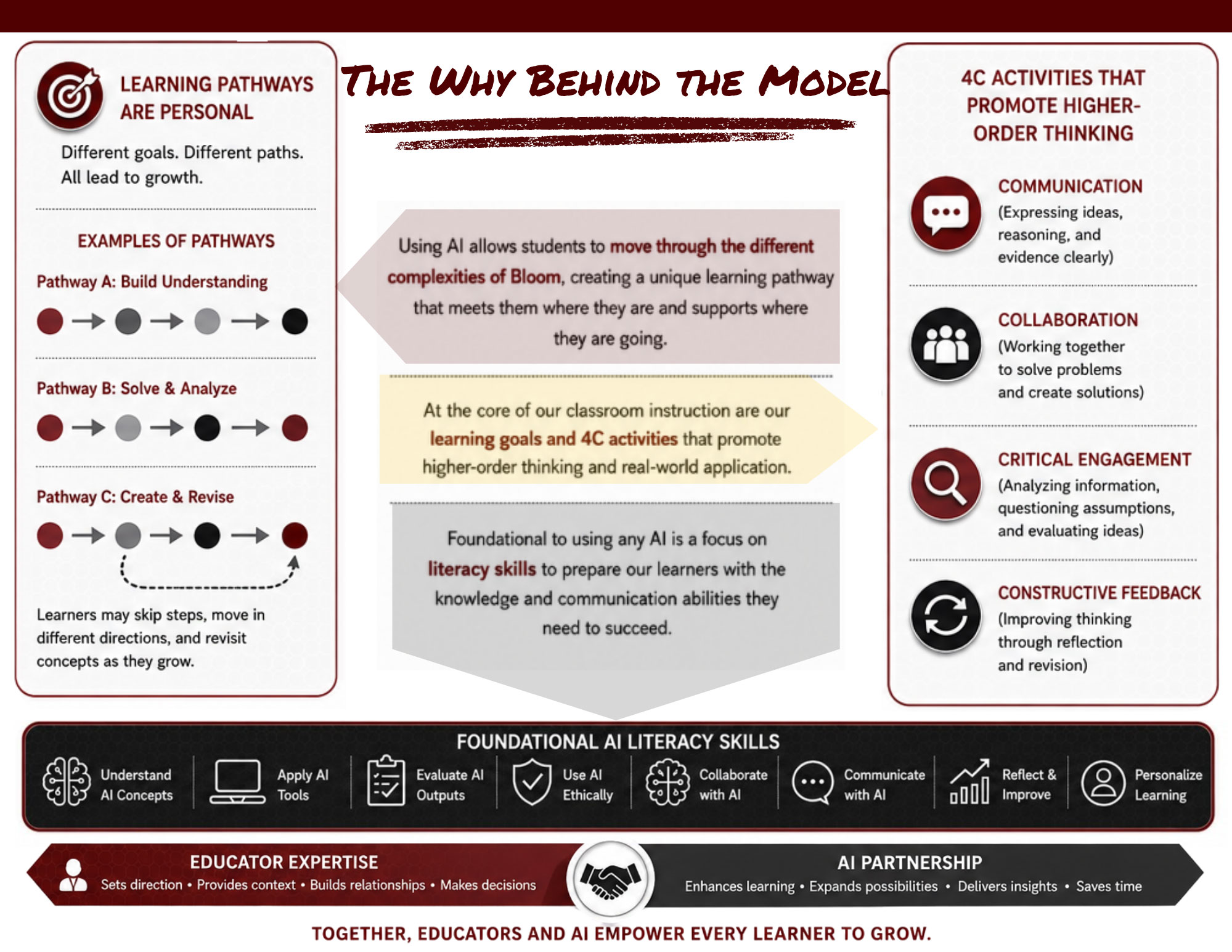 [Click on image for larger view.] AI-Supported Personalized Learning Pathways Framework (Part 2) (source: Zion-Benton Township High School District 126).