Research

10.5 Million PreK-12 Students Will Attend Classes Online by 2014

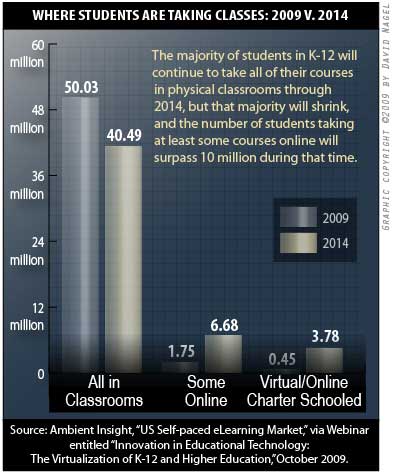
More than 2 million preK-12 students take some form of schooling online right now--whether attending a virtual school for all their classes or just taking one or more courses via the Internet. But while the vast majority of students will continue to take all of their courses in physical classrooms over the next five years, the number of students taking courses online will jump to more than 10 million by 2014, according to data released recently by research firm Ambient Insight.

According to Ambient Insight Chief Research Officer Sam S. Adkins, already about 450,000 K-12 students attend virtual schools or "cyber" charter schools full-time, while another 1.75 million take some of their classes online. The two groups are still outnumbered by students who take all of their courses in physical classrooms, which Ambient Insight reckoned at 50.03 million as of 2009.

But this situation will change somewhat by 2014, at which time, Adkins forecast, the number of students taking all of their courses in physical classrooms will drop to 40.49 million, while 3.78 million will take all of their classes online, and 6.68 million will take some of their classes online.
 

The information was presented in a Webinar that coincided with a new report from Ambient Insight focusing on the growth of the electronic learning market (in terms of dollars spent on products and services) from 2009 to 2014. Titled "US Self-paced eLearning Market," the new report highlighted some of the dominant segments in online learning. Of the individual segments spotlighted in the research, healthcare was projected to see the most growth over the next five years. But K-12 and higher education growth followed in second and third position, respectively, for a combined academic projected growth percentage greater than that of healthcare. K-12 was projected to grow about 18 percent by 2014; higher education was projected to grow more than 8 percent. Healthcare was projected to grow a little less than 20 percent over the next five years.

"The rate of growth in the academic segments," said Ambient CEO Tyson Greer, in a prepared statement, "is due in part to the success and proliferation of the for-profit online schools."

Across all segments, the market for electronic learning products and services, at present, is $16.7 billion. According to the report, this will grow at a compound annual growth rate of 7.4 percent over the next five years to $23.8 billion in 2014.

"In the past two years, the rate of growth for online learning products has slowed," Adkins wrote in a statement. "Yet, despite the recession, and in many cases, because of it, the demand is positive in all the online learning buyer segments....."

An executive summary of Ambient Insight's report, "US Self-paced eLearning Market," can be found here. The full report runs $4,825. Ambient will also be releasing a worldwide report on electronic learning in November. We'll have more information about that when it becomes available.

About the Author

David Nagel is the executive producer for 1105 Media's online K-12 and higher education publications and electronic newsletters. He can be reached at dnagel@1105media.com. He can now be followed on Twitter at http://twitter.com/THEJournalDave (K-12) or http://twitter.com/CampusTechDave (higher education).

Comments

Mon, Oct 10, 2011 jim los angeles

kids who are attending 100% online schools (such as my 13 yo. for two years) are mostly advanced and have plenty of friends near and far. They are mostly from good income well educated families. Please note (Shila et al) there are also positive " unintended social consequences" namely advanced kids can study at their own rate without exposure to drugs and disruptive behavior by kids less motivated, and bullying. Kids online need to be self actualized and being so means that they usually take care of all facets of their own education including the social aspect. Advanced kids behave pretty much the same whether attending bricks $ mortar or online. Problem is that academically advanced lower income children need to be presented with online education opportunity also....which means that most bricks and mortar schools will end up with the worst case students, low motivation and low income.... Online education currently is technically superior to bricks and mortar for many reasons, the most significant of which is online learning materials and reporting systems are extremely superior to bricks and mortar schools. take a closer look, if you have children 10years old or older online will benefit them greatly. most parents will make excuses only because online is rather inconvenient for both working parents since they need a baby sitter more than a school for their kids.....and cannot leave a child at home alone to study. Currently Online is a luxury in this respect. Soon a hybrid edu model will surface combining online with a physical place to go with live guardians or monitors to keep the kids safe and behaving. very soon. thanks for your time.

Thu, Nov 11, 2010 Tom

Angela, I would like to be in contact with you after I read your experience with online school. Please send me an email to van00013 at yahoo. Thanks.

Mon, Jun 21, 2010 Angela

I am a product of a home based education, I complete 6 years of high school and junior high in two years, I graduate high school at 15 and attended college – earning a bachelors degree and am seeking my Law degree. I would like to respond to those that seem to imply, we are lacking in social skills, simply because we do not attend a traditional school. There are more ways to be socialized, then 'playing with friends' on a schoolyard. We are not locked in basements to study, we are in fact, often encouraged to get out and talk to people, to volunteer, to explore items of interest to us, whether it be horseback riding, or drawing, writing, etc. We realize that there are more ways to learn than by books, tests and being compared to someone else. We learn from experience and from others. We often test equally, if not higher, then those educated in a public school- and are often taught more valuable skills than most schools teach. We are taught accountability, self-initiation, self reliance, self respect and accomplishment and extensive researching skills. We may have a teacher telling us, I want a 3 page essay on the first world war, but we also have the most important instructors, ourselves and our parents. We are on our own to do the research, form the thoughts and articulate it to some one else. There is no options of cheating off you neighbor- of sliding by because you are an athlete or you slipped through the cracks. You work for it, you earn it and you learn to push yourself and be proud of your accomplishments. The influential lessons in our lives are learned early in childhood- agreed. These lessons begin with walking, talking, reading, writing, counting, and of course potty training. These are not skills you learn from a public school- you learn these from your family, friends, neighbors, etc. Furthermore, some very well known and influential people have been the products of homeschooling; Benjamin Franklin, (Declaration of independence signee), Thomas Edison (inventor of the inflorescent light bulb, etc.) , Authors as Charles Dickens and even humanitarians and Florence Nightingale. Homeschool is often misjudged by those who are misinformed, uneducated in relation or stereotyping.

Fri, Jan 22, 2010 Scott Merrick Nashville, Tennesse, USA

Interesting article and interesting comment thread. I work with educators who are interested in developing educational potentials inherent in virtual environments, and I'm curious about the implications of these numbers and predictions for those technologies. Will the "sense of place at adistance" that 3D virtual worlds offer and delivers provide some measure of the social interaction that seems to be missing in online learning? The answer is likely in the affirmative. It's a rich and fertile field for research and development, led by innovative pioneers who clearly see that the old paradigms just don't cut it anymore. My own prediction is that the most effective and successful online education providers will include some version of a 3D virtual world in the future, and not in the distant future...Reference Second Life, ReactionGrid, ScienceSim (online search engines will provide a wealth of informative results when any of these terms is paired with "education."

Tue, Nov 10, 2009

Shila I think that your a 13 year old and did this in school like I am now so anyways you are right, people are idiots and don't consider others as well as them so your right, they are gay, end of story, i like pie, and applesauce

Mon, Nov 9, 2009 Shila

If you people have not noticed yet.... this is going to cause social issues. Children who are homeschooled or take classes online miss out on many oppurtunities during their chidhood years. This will affect their abilities on how they interact with other people and their abilities to build off of other people.

Thu, Nov 5, 2009 Mike Harrington

Dinner time conversation

Wed, Nov 4, 2009 Bill Naples

The stage is set for best practices in education to served up online to children the world over. Technology has reached a point where even the most remote locations have access to the internet. The existing educational paradigm is dead. If you would like to be involved in a global online education poject. Please feel free to email me at cwcolburn@aol.com

Wed, Nov 4, 2009 Muvaffak GOZAYDIN Turkey

Dear Laura Believe me nobody in the world can afford brick and mortar school anymore. Even USA and even Switzerland. Brick and mortar requires building, land, heating, cooling, maintenance, administraters, water, electricity, cleaning, desks, chairs, papers, pencils , and TEACHERS ( usually they are not well trained and well paid )etc etc. ONLINE : you spend only once $ 1.000.000 per 100 session per year course. If it is accessed by 100.000 students per year, cost is only $ 10 per student. If you amortise it in 5 years cost is only $ 2 / student / year. And quality is perfect. Prepared and develeoped by the BEST teachers of the world in Washington DC. Cost of cheapest face to face education is $ 20.000 / year/ student in USA and almost anywhere in the world. If it is less than that, we do not call it school. It is a schack. How can you compete. Coming to socilising. You can have and even today you have, many clubs for sporting, musics, photography, sailing, fun clubs etc etc. They much cheaper than brick and mortar school. Plus you choose with whom you want to be. I try convince my American friends that GOOD ONLINE is 10 times better than face to face. Not commercial online. First thing USA should do 1.-Prepare a National curriculum in DC 2.- Have a contest for ONLINE COURSES Development 3. Choose 1 or 2 content to be used all schools in USA If we we in Turkey had done it so USA can do it. Best regards. By the way USA namely Caltech and Stanford educated me for 8 years. mgozaydin@hotmail.com

Wed, Nov 4, 2009 Muvaffak GOZAYDIN Turkey

Dear Dave Nagel : Thanks for such a nice report. I think there is some small mistake in the Nacol anouncement. It says Preschool ONLINE will reach to 10 million or so. I am from Turkey. I work for online for the last 15 years even before many schools in the USA. Now we have in TURKEY, in Turkish and in English a National Curriculum ONLINE courses for 15.000.000 K12 students FREE FREE FREE. First in the world. I was the initiator of that project in 1995. All Turkey is covered by ADSL. Only shortage is now netbook for everybody. We have 1.500.000 somehow computers at schools + about 1.000.000 at homes of better of families. We are ready to export about ONLINE courses in English to USA. It is proven project. Only obstucle now is training of teacher for online. Students, believe me , even learn faster than their teachers. Our online program train the teachers in their subject as well. In the USA there are 55-56 million K12 students and only less than 1.000.000 students can take ONLINE Courses. Too bad. MAIN PROBLEM IN USA IS SCHOOL DISTRICTS MODEL. USA MUST HAVE A NATIONAL CURRICULUM MADE BY THE BEST EDUCATORS OF THE WORLD IN Washington DC Now we need ONLINE PRESCHOOL Content and KNOWHOW from you. Can you help me mgozaydin@hotmail.com of Turkey +90 - 532 - 291 96 76

Sat, Oct 31, 2009

As an educational technologist, I find this great yet a possible issue in that the social factors of brick and mortar institutions are high enough, what will happen an online environment? Although distance & online learning will drastically increase, there will still be a great number of individuals who prefer the traditional approach to learning. As far as funding, great question. I think that the funding will plateau, but if brick and mortar institutions still facilitate a learning space for students who wish to attend the online classrooms, I see it as a new stream of funding....maybe one that we can see being applied effectively.

Fri, Oct 30, 2009 Editor

There will presumably be information on China in the global report, which will be released within the next 30 days. --David Nagel

Fri, Oct 30, 2009 zion beijing,china

how about the market of k12 in china in future? i think it should be a huge market in online study or eschool in china! but the policy could be the biggest obstercal to increase !hope to hear more info or report related chinese market!

Thu, Oct 29, 2009 Editor

Laura, I think you would be interested in the discussion with Susan Patrick we posted today. It does discuss funding extensively. Read it here.

Wed, Oct 28, 2009 Andrew Pass Farmington, MI

Thanks for sharing this important information. As the publisher of a small educational publishing company that develops core curriculum resources atop Web 2.0 technology, I am always interested in learning more about the size of the digital curriculum market. Andrew Pass http://www.pass-ed.com

Wed, Oct 28, 2009 Laura

Two thoughts: How will this affect mortar and brick school funding, and what are the unintended consequences of the social isolation inherent in the online school format?

Add your Comment

Your Name:(optional)
Your Email:(optional)
Your Location:(optional)
Comment:
Please type the letters/numbers you see above

White Papers:

  • Desktop Virtualization in K-12 Schools: Reducing Costs, Saving Time And Delivering Anytime, Anywhere Access for Students and Staff PDF screen shot

    This paper will show how desktop virtualization can positively position educational institutions for the future, enabling them to reduce expenses through hard dollar savings and time efficiencies while delivering the experience that students, faculty and staff need and desire. Through the experiences of Babylon School District, as well as Manchester Essex Regional School District in Massachusetts and Rockford Public Schools in Michigan, we’ll paint a picture of how desktop virtualization can revolutionize education’s approach to delivering technology — an approach schools can actually afford. Read more...