Crestron Debuts Audio Processor and Companion Amp
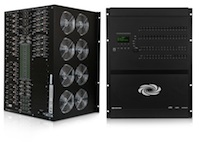
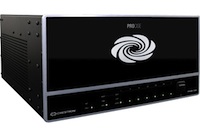
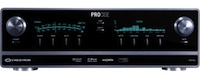
Crestron's DM-MD32x32-RPS matrix switcher (top), 7X400 amplifier, and PSPHD audio processor |
Crestron has unveiled a new 7.3 surround sound audio processor along with a series of matched amplifiers for use in auditoriums, classrooms, and conference rooms. The company also debuted three new matrix switchers.
Part of Crestron's Procise series, the audio processor, dubbed the PSPHD, offers a built-in three-channel line mixer that supports microphone mixers and codecs. All three channels of the mixer come with fully programmable notch filtering, compression, gating, and a four-band equalizer.
Effects and audio controls of the PSPHD include GEQ Gain, PEQ Gain, Delay, Compression, treble and bass adjustments (±12 dB), and a master volume adjustment ranging from -80dB to +20dB.
The processor ships with automatic room compensation, a technology used to adjust output based on the available space, and pure mode, a setting that bypasses signal processing.
Other features include dynamic volume control, the ability to act as a transport for HDMI video signals up to 2,048 x 1,152 (progressive), XLR balanced inputs/outputs, and RJ-45 connectivity.
The matched series of amplifiers, the PROAMP 7X400 and PROAMP 7X250, have a crosstalk of 105 dB, a gain of 23 dB, and a dampening factor of less than 250 watts.
Both amps support seven channels and are designed to sync with the PSPHD using an Ethernet connection.
The 7X400 has an output power of 400 watts per channel with impedance of 8 ohms, while the 7X250 outputs 250 watts per channel with the same impedance.
Also introduced by Crestron were three matrix switchers, the DM-MD8X8-RPS, the DM-MD16x16-RPS, and the DM-MD32X32-RPS.
The switchers use a modular design that incorporates input and output cards for customization. The DM-MD8X8-RPS has eight input slots and two quad output slots, while the DM-MD16x16-RPS offers 16 inputs and four quad outputs. Offering eight quad outputs and 32 inputs, the DM-MD32X32-RPS is the largest model.
All three models ship with redundant power supplies with a mean time between failures of 1 million hours and an operating efficiency of 85 percent each. If one of the power supplies fails a red indicator light flashes and the other power supply takes over at 100 percent capacity.
The switchers support resolutions up to 2,048 x 1,152 (progressive) and a variety of input cards, all of them with a passthrough output that can be daisychained.
The PROAMP 7X400 and PROAMP 7X250 are currently available, while DM-MD8X8-RPS, the DM-MD16x16-RPS, and the DM-MD 32X32-RPs will ship later this month. At the time of this writing a ship date for the PSPHD had not been published.
Further information is available here.
About the Author
Dan Thompson is a freelance writer based in Brea, CA. He can be reached here.