NEC Intros Ultra-Short-Throw Interactive Projector Bundles
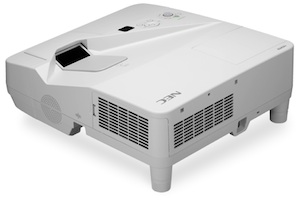
The new NEC UM-series projectors offer up to WXGA resolution and a 3,300-lumen brightness rating.

This January NEC will ship two new ultra-short-throw LCD projectors, both to be available with in bundles that provide interactivity using the company's eBeam technology.

The UM330X is an XGA-resolution projector (1,024 x 768 pixels) with a brightness of 3,300 lumens and a contrast ratio of 3,000:1. The UM330W has a native WXGA resolution (1,280 x 800 pixels) but is otherwise nearly identical to the UM330X.

Both are designed for extremely short throw distances, as little as 17.64 inches to produce a 58-inch (diagonal) image on the UM330U and a 61.5-inch image on the UM330X. They're also designed to be used with the optional NP02Wi eBeam interactive system, which allows for functionality similar to that of an interactive whiteboard using a small receiver and compatible stylus.

Other features include:

  • 1.4x zoom;
  • Wired and optional wireless LAN;
  • USB viewer;
  • Closed captioning support;
  • Integrated wall color correction;
  • Automatic or manual keystone correction ±10 degrees;
  • Carbon savings meter;
  • Virtual remote; and
  • Integrated 16 watt speaker.

AV inputs includedual HDMI, RGB (mini D-sub 15-pin), S-video, composite video, mic, and stereo minijack. AV outputs include monitor out (mini D-sub 15-pin) and variable audio out (minijack). Networking and control ports include wired LAN (RJ-45), optional wireless LAN, three USB ports, RS-232, IR, and DDC/CI. The units measure 16.9" (w) x 23.3" (d) x 4.4" (h) and weigh in at 12.6 pounds.

The UM330X and UM330W will both be available in January. The XGA UM330X will run $1,099 as a standalone unit or $1,299 with a wall mount bundle. The WUXGA UM330W will sell for $1,318 individually or $1,518 with a wall mount bundle. The eBeam NP02Wi sells for $489. Additional details can be found on NEC's projector portal.

About the Author

David Nagel is the former editorial director of 1105 Media's Education Group and editor-in-chief of THE Journal, STEAM Universe, and Spaces4Learning. A 30-year publishing veteran, Nagel has led or contributed to dozens of technology, art, marketing, media, and business publications.

He can be reached at [email protected]. You can also connect with him on LinkedIn at https://www.linkedin.com/in/davidrnagel/ .


Featured

  • digital brain integrating legal regulation and security interface

    Survey: Agentic AI Moves from Pilot Phase to Production, Bringing Governance to the Forefront

    A new report from Caylent, an AI-focused Amazon Web Services Premier Tier Services Partner, found that enterprises are already moving agentic AI beyond pilots and into production environments. At the same time, organizations are putting strict conditions around autonomy, making governance and control the next major challenge for enterprise AI adoption.

  • abstract smartphone translucent screen displaying AI interface

    Apple Unveils Redesigned Siri AI

    At its recent Worldwide Developers Conference, Apple announced Siri AI, a redesigned version of its voice assistant that Apple describes in its own announcement as "a profoundly more capable and personal assistant." The update is intended to make Siri more conversational, more context-aware, and more useful across iPhone, iPad, Mac, Apple Watch, and Vision Pro.

  • large cloud icon with abstract code  and interconnected polygons

    Report: Enterprise AI Workloads Are Tipping Toward Private Cloud

    Broadcom's 2026 Private Coud Outlook report says enterprise AI is moving from experimentation into production, with private cloud emerging as the preferred deployment environment for AI inference among surveyed organizations.

  • education funding and graduation symbols on wooden dice

    What Is the Education Freedom Tax Credit and How Will It Work?

    The federal Education Freedom Tax Credit (EFTC) is a new source of funding for education that could benefit 90% of students in states that have opted in to the program. However, some confusion and misconceptions exist surrounding details of the program, including which programs may qualify, how parents can apply for scholarships, and how public school students can benefit.