Integrating Programming with Core Curriculum
There has been a steady and growing call for more students to learn computer programming. As they try to answer that call, some educators are looking beyond stand-alone lessons or separate programming classes and integrating coding into their core curriculum.
- By Jennifer Roland
- 10/03/13
There has been a steady and growing call for more students to learn computer programming. In an app-centric world, many see the immediate possible benefits of a more highly skilled workforce that can create the computer-based tools we all depend on. And tech companies love the idea. Adobe's Worldwide Education Programs Lead Tacy Trowbridge said coding is "an important and increasingly relevant form of creative expression" that has been instrumental in the growth of their business model to the cloud.
As they try to answer that call, some educators are looking beyond stand-alone lessons or separate programming classes and integrating coding into their core curriculum.
Beaver Country Day School (BCDS), a private school for students in grades 6-12 located just outside Boston, launched a school-wide coding initiative this academic year to help prepare their students for a new world of work and to, they hope, encourage more students to study computer science in college.
However, rather than just offering required stand-alone computer science courses, said Math Teacher and Department Head Rob MacDonald, they are integrating it into the core curriculum.
"I've actually been teaching a very successful coding elective for several years now," he said, "but I was thrilled when I got the okay to integrate coding into our core math courses." MacDonald said he had been interested to hear about "interesting work around coding that was being done in schools, makerspaces, and extra-curricular programs, but very few places seemed willing to take the leap and make coding universal."
Geometry was his first target when he looked at creating lessons. "Geometry is a course where logic, spatial reasoning, and problem-solving are the big skills we're trying to build, and all of those skills can be built through coding," said MacDonald. And he and his team spent the past year creating activities that cover the mathematical skills students need to learn and that teach coding essentials. One such activity is to write a program that has a bouncing ball. MacDonald said some of his students envision a pool table environment where they must account for the physics and geometry of bouncing the balls off the table walls. Others visualize it as a basketball bouncing in a gym — those students need "to think about transformations of quadratic functions."
In a piece BCDS School Head Peter Hutton wrote for the Huffington Post, it is clear that one of the major goals of the coding program is to encourage more students to study computer science and fill some of the projected shortfall in computer science-focused jobs.
However, other educators are focusing more on the soft skills learned through programming. And one of them — Karen Mensing — is using it with her first and second graders at Fireside Elementary School in Phoenix, Ariz.
Mensing also tied her coding assignments into the core curriculum, asking students to use Scratch and Star Logo to create games that use the math skills they are learning or the spelling words of the week. As with many assignments that ask students to teach what they are learning in class, using these concepts as the backbone of a game helps them solidify their learning and, she said, develop their higher-order thinking skills.
| |
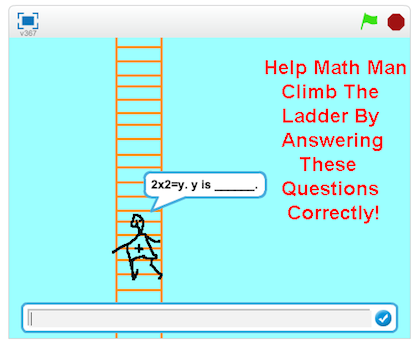
Students in Karen Mensing's second grade class use Scratch and Star Logo to create games that use the math skills they are learning or the spelling words of the week. |
|
"It's amazing to see how much a six- or seven-year-old can accomplish," Mensing said. "I am not a coding expert," she continued. "I know the basics, but they run with it." Mensing said she sees coding as "a method to be interested in learning," rather than the learning outcome itself. And her students definitely follow through. "They'll go home and they'll work on it all night because they are so fascinated."
Josh Sheldon, project manager with MIT's Scheller Teacher Education Program and Center for Mobile Learning, said he agrees that is the real power of coding instruction. The shift that happens in a student's mind when they realize they can create apps and games rather than just being a passive consumer is "where the real magic lies," he said.
One example he mentioned is the Verizon Innovative App Challenge, which is a contest open to middle and high school students. Students work in teams to create an idea for an app. The winners get the chance to learn how to actually create it. The contest is powerful, Sheldon said, because it "starts to enable that empowerment by saying, 'you too can be an app creator,' but it doesn't require the coding initially." He recalled one middle school girl from a winning team from the Bronx who said "I never dreamed I could be an app developer. And now I want to be one." That, he said, "just is an amazing story."
In addition to empowering students, Sheldon said he believes coding helps students learn to think at a deeper level. It is a means of teaching what he called computational thinking, which "involves things like being able to break down a problem into its constituent parts and solve them piece by piece and then reassemble them into a whole towards the end."
In fact, Sheldon said, that type of thinking is much more important than learning any specific programming languages or concepts. It leads to the type of adaptability students will need during school and afterward, no matter what career they end up pursuing. Computational thinking, he said, is one of many tools a creative person can have in their toolbox.
That idea ties back into MacDonald's goals for his students. "Chances are that any language we teach them now will be basically obsolete within 10 years," he said, "but if we focus on the big skills, kids will be able to apply those skills to whatever they encounter in the future."
And for teachers who are worried their kids are too young or won't be able to handle complicated programming assignments, Mensing offered this piece of advice: "If we set the bar high, they will rise to it."