CoSN Issues Guidelines for Designing Optimal Education Network
- By Dian Schaffhauser
- 03/07/14
A professional association of K-12 IT leaders has defined the specifications for a district network that can keep up with current and future instructional and learning requirements. Among the recommendations: to confer with teachers and administrators regarding classroom technology use at the start of every education-focused network planning process and then to train them as part of every technology rollout.
The guidelines come from the Consortium for School Networking (CoSN) as a part of its "Smart Education Networks by Design" (SEND) project. The goal is to provide best practices and suggestions for designing, implementing and managing networks that will support district planning that can keep up with a continuing increase in computing devices, all requiring more connectivity.
"In today's dynamic education landscape, everyone shares the goal of providing our children with the best opportunity to prepare for college and career success. Doing so, however, requires strong investment in establishing a school system-wide infrastructure that enables connectivity and innovation at all learning levels," said Keith Krueger, CEO of CoSN. The first resource, consisting of the guidelines and a checklist, will help technology leaders design, deploy, and leverage "smart education networks" that are "resilient and durable," he added.
Other recommendations referenced in the 62-page guidelines are these:
- Acknowledge the importance of the education network as one of the "most critical infrastructure components" of a school's operation;
- Accept that 1-to-1, many-to-1 and bring your own device (BYOD) or technology programs are going mainstream and that bandwidth capacity needs to support these;
- Recognize that enabling students and teachers to get to content and resources outside of the classroom is just as vital to learning as in-class connectivity is.
- Security must be "rigorous" and built into the network design to stop unauthorized access and to comply with federal and state laws regarding student privacy and protection;
- Make decisions regarding the network design that will scale and support new device capabilities and technologies; and
- Work under the assumption that some portion of the student population may not have high-speed broadband at home. To support those students around the clock, districts need to use Wi-Fi and cellular networks as part of their designs and adopt devices that are mobile broadband enabled.
| |
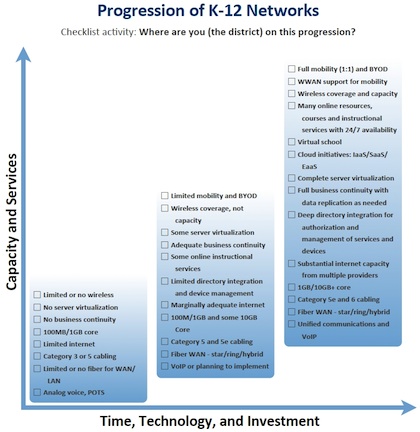
CoSN's five-page checklist suggests an expanding track of technological maturity for districts. |
|
The five-page checklist developed by CoSN suggests an expanding track of maturity in which "time, technology and investment" can move a district from "basic connectivity for supplemental enrichment" at the lowest level to "emerging reliance" on digital resources and finally onto "transformation to a technology-rich learning environment," the most mature level. The basic level, for example, is characterized by limited or no wireless and no server virtualization; the mid-tier has limited mobility and BYOD and some server virtualization; and the most mature districts have full mobility and BYOD or 1-to-1 and full server virtualization.
CoSN's SEND project is supported by Qualcomm Technologies. The advice is vendor-neutral.
The SEND materials can be downloaded through a free registration process at the CoSN Web site.
About the Author
Dian Schaffhauser is a former senior contributing editor for 1105 Media's education publications THE Journal, Campus Technology and Spaces4Learning.