MIT Offers STEM Summer Institute for Middle School Students
Students entering grades 6-9 in the Boston, Cambridge and Lawrence, MA area recently had an opportunity to learn about science, technology, engineering and math (STEM) concepts as part of a STEM Summer Institute offered by MIT's Office of Engineering Outreach Programs.
The institute was taught by 15 instructors, mostly graduate and undergraduate students, who "worked closely with expert mentors to prepare their curricula, and academic advisors provided additional student and instructional support," according to an MIT news release.
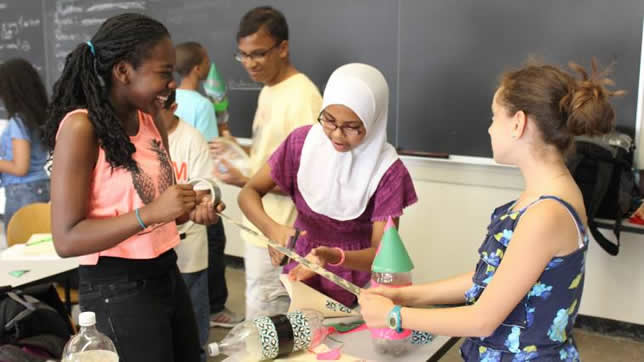
The 86 students who attended learned about eight subject areas, which included:
- Algebra and biology for students entering grade 6;
- Chemistry and physics for those moving into grade 7;
- Rising eighth-grade students studied probability and statistics and engineering design; and
- Students entering grade 9 focused on pre-calculus and robotics.
"A primary goal of the program — which is offered free of charge due to generous support from individuals, foundations, corporations, and MIT is — to empower local students with the skills and confidence needed for future success in technical careers," according to information released by the school.
"I really want to inspire minority students to work in the STEM field," said Probability and Statistics Instructor Mia Bernardino, a civil engineering major at Seattle University, in a prepared statement. "There are not many women in the civil engineering field, or engineering in general. I want to be an example for other young women, to show that they can be like me one day and teach others."
About the Author
Joshua Bolkan is contributing editor for Campus Technology, THE Journal and STEAM Universe. He can be reached at [email protected].