Tech Start-Up Hosts Hackathon for Online Course Gadgets
- By Dian Schaffhauser
- 09/02/14
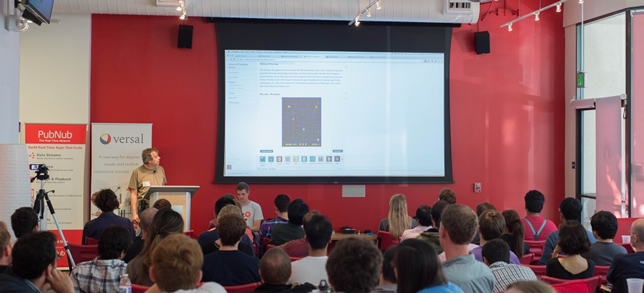
A start-up company with an online application that allows people to create and publish interactive courses recently held a "Code for Education" night in its home town of San Francisco. Versal invited both coders and non-coders to form teams or work on their own to build educational JavaScript apps, which it calls "gadgets." These are drag and drop components that users can plop into their Versal-built courses to add interactivity. Prizes for the top efforts included Chromebooks and contracts to complete the gadgets.
Versal's platform, which is designed to be used by non-technical people, starts with a canvas upon which the course author adds text, video, images and files, and interactive activities via the gadgets. Once a course is built, it can be delivered to students through a direct link or embedded into social media sites, blogs and the company's course catalog for public consumption.
A "Pro" version, which is $5 per month or $50 per year, adds functions specifically for educators in K-12 and higher education: progress tracking of assignments and projects for up to 200 learners each month, as well as the ability to create private courses available through invitation.
Versal is encouraging instructors to use the software not only to create their own online materials for blended courses, but also to assign projects to students, in which they research a topic and create their project right in the program.
Parent and developer Sebastian Belmar attended the coding event to work on a gadget that has a visual collection of data and demographics. "This gadget helps students better understand data and get excited about what they are learning, bringing the data to life," he said.
Taha Kazi, a technical account manager at education tech company TenMarks, and Robby Nevels, a software engineer at Facebook, met at the event and began working on a sound recording gadget that would allow teachers to record in real time and integrate voice while they create their lesson plans. Kazi is a board member with Enabling Minds, a nonprofit helping to teach disabled people and children with "intellectual disabilities" in Haiti, and came up with the idea based on his work with that organization. The goal is twofold: to allow teachers to develop courses for their special ed students who have difficulty learning language, and second, for student use. "With this gadget teachers could develop a course that shows an image of a water bottle and students [could] hear the sound 'water bottle' at the same time," he said. "Or in the future, students could record themselves for their teachers, and teachers could measure [the] student's reading ability."
"This event is great because it brings together a lot of creative and smart people who are all interested in creating something better for education," said Versal CEO and Co-Founder Gregor Freund. "I'm really impressed by everyone who came out tonight and very excited to see what they have come up with and built."
About the Author
Dian Schaffhauser is a former senior contributing editor for 1105 Media's education publications THE Journal, Campus Technology and Spaces4Learning.