Beyond Programming: The Power of Making Games
- By Lisa Castaneda, Manrita Sidhu
- 02/18/15
"I gained a lot of skills! These skills include more computer skills which I did not have before, along with a different outlook on life. I began to see all of the opportunities in everyday life for different games and ideas. I gained a new perspective on an old picture." — 8th grade student
"Creating something out of nothing. It's the closest thing to magic I can think of." — Game developer
A Broader Perspective for Learning
Art and creative expression have an interesting way of weaving in and out of classrooms, offering students the opportunity to explore their own ideas and minds. Video games are no different, and while most of the discussion about their use in classrooms centers on play, we at foundry10 wanted to examine the value of making games. Through easily accessible programs such as Scratch and Gamemaker, students from early elementary up through college are creating games and learning while doing it.
We gathered surveys from 107 game design and development professionals and 300 middle school students, before and after a game development class, about the value of teaching game development in a middle school class. Then we compared the responses of the 7th- and 8th-graders with what the game developers said they felt would be important about making games. We hope this information will help teachers who are constructing game development classes, and show the broader view of the value inherent in game development that professional game makers can provide.
Game Development Is Far More than Just Plain Old Programming
Making computer games can be a great entry point into computer science. Writing code is a major part of making video games, and 58 percent of the professionals surveyed said that programming was a key element of game development. However, they were quick to point out that the great thrill of programming for game development is to make games enjoyable for others.
This consideration for how others experience games is at the heart of game development, in the form of both imagining another's experience of the game and direct feedback by users. It's not coding just to code, it is coding to create something fun for others.
"Game creation is an art of understanding and bending perception of a user... Even if it is ultimately used outside the scope of game creation." — Game developer
"You need to be creative, open minded to anything that comes at you. You need to think outside of reality. You also need to be determined and focused." — 8th grade student
Students indicated that coding was an enjoyable aspect of their course. Oddly, they often didn't recognize the games they were creating were made for their classmates to play. This seems to be a key component of a game development course, as reflected by the professionals' experience in the field. Perhaps highlighting this aspect for students would add to their experience in a positive way.
In the survey, 35 percent of the professionals mentioned creativity, design and the arts as inherent to the value of making games. Also, 44 percent said they thought these concepts should be emphasized in a middle school game creation course. A much smaller percentage of students, 10 percent of 7th graders and 3 percent of 8th graders, said they saw creativity and the arts as a valuable component of game development whereas only 6 percent of the 8th graders said they felt these skills were gained. Game development is an excellent opportunity for students to express themselves creatively. It seems that emphasizing the importance of the more creative and artistic elements might serve to enhance students' overall experience and understanding of what it means to make games.
Developers also said they felt that creating a game requires the use of core skills (like math and science), logic, storytelling and sound design. Conceptualizing game development courses as a multidisciplinary opportunity for students could help instructors create a more transferable experience to the real world resulting in a richer, more broadly applicable experience for students.
The Value in Game Development Goes Beyond Strictly 'Academic' Values
Game developers indicated that middle school students can hone many non-academic skills through the process of creating games such as teamwork, persistence, empathy, willingness to fail, project management, critical thinking, risk and reward analysis and goal setting. The instructor we studied purposefully tried to replicate a game studio setting in his classroom. Students had the freedom to collaborate and work in a flexible way with one another, much like in a real-world setting.
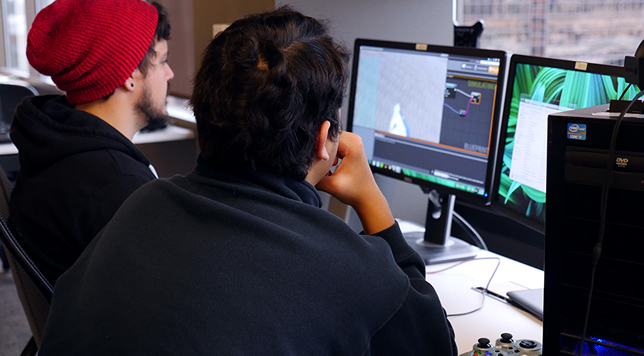
"I gained experience of working in groups to complete a big goal. I learned how to properly start a project and complete it properly. I learned teamwork skills that have helped me in other classes." — 8th grade student
"Games are complex and require people to refine many abstract thoughts into a refined idea that can be executed, not just sound exciting. Very few school classes teach this ability." — Game developer
Making games requires students to think critically about their own ideas and their ultimate goals for their project. The ability to "contain one's ideas" came up repeatedly among the developers. Being able to look objectively at ideas, decide what is realistic, and make a plan to move forward requires a high level of thinking and planning. The professionals said they felt that such executive functioning skills were some of the most important things that young game makers should practice and develop.
Learning To Fail and Discovering Abilities We Didn't Know We Had Is Perhaps Most Important
Developers referred to the cyclical process of game design, where an action is followed by testing and revision, or iteration. Another way to conceptualize this is that students learn to "fail" over and over and how to rebound from each situation. That grit and determination, the willingness to keep working in order to make the game "work," is all part of the constructivist mindset that game development entails.
"Determination, persistence, and getting up when you're knocked down, as well as versatility and resourcefulness, are necessary. Actually, necessary may be an understatement — 100 percent vital skills is a better term, I suppose." —8th grade student
"The breakthrough moment when you look at the sum total of all the known work lying in a disorganized pile in front of you, then suddenly realizing what you can do to make it all logically fit together." — Game developer
When we gauge learning by testing, it is easy for learners to feel like making mistakes is a bad thing. However, the iterative nature of game play and game development allows for failure and frees the learning process. Students become more accustomed to things not working right and yet are empowered to play around and work better.
We have found that creating games often allows students with different skillsets to emerge in new and more positive ways in the classroom. Many students referenced their own surprise at their broadening talents, especially the girls who took the 8th grade elective game development class.
Over the time game development was offered at this middle school, the percentage of girls who took an elective course in 8th grade doubled from 8 percent in 2010 to 16 percent in 2015. This seems to stem largely from how this school made a short game development course mandatory in the 7th-grade curriculum. This resulted in an increased number of 8th graders who reenrolled in the more advanced course. At the beginning of the course, many said they did not see themselves as "game developers" but, by the end, had remarked how they did acquire skills in several aspects of game design.
Seizing the Opportunity
We have to help make the more holistic aspects of game development explicit for students. Even if they work in a team, thinking critically about solving problems and demonstrating qualities such as perseverance and determination are capacities that students should recognize they are learning. The same holds true for more concrete technological skills and computer science-based skills. If students don't recognize they are learning these principles, they may not feel that they have the ability to apply them to fields like computer science.
We encourage all teachers of game development courses to consider how professionals think about making games in the real world. Capturing some of the broader elements inherent to design will not only enhance the classroom experience but may even draw a wider array of students into the classes in the first place. Game development courses have value on countless levels. It would be a shame if students and educators didn't appreciate all of the things they could learn.
A current focus in many schools is coding and computer science. We think that courses such as game development provide a great way to teach those skills but allow for other important skills to emerge, especially creative and artistic elements. Novices in game development may see a very narrow spectrum for the learning potential with making games. Professionals see the possibilities more broadly and we can learn from that. We believe that if we don't try to capture some of the breadth inherent to game development, we may miss its powerful educational opportunity.