Micro:bit Foundation Brings Small-Board Computer to United States and Canada Classrooms
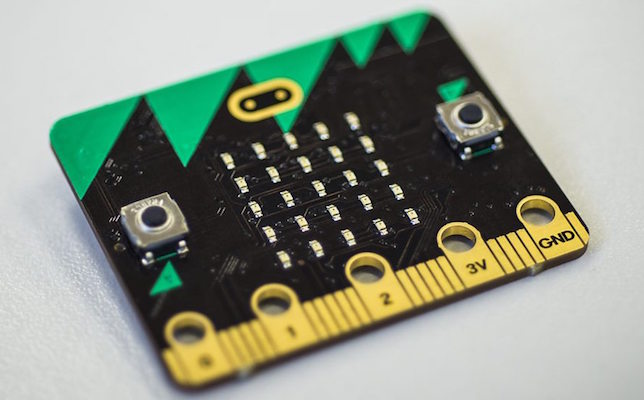
Image: Micro:bit Educational Foundation.
The Micro:bit Educational Foundation, based in the United Kingdom, today opened up availability to its small-board computer for education customers in the United States and Canada.
The micro:bit is designed by BBC for use in computer science classes and priced starting at $14.95, according to information from the nonprofit organization. It is roughly the size of a credit card and comes equipped with 25 LEDs that can display simple images and text; a variety of sensors; as well as two programmable buttons. Additionally, the micro:bit can connect to other devices via Bluetooth.
Since it’s meant to teach students computational and critical thinking skills, it can be programmed via PC, tablet or mobile using Scratch, a block-based coding language from MIT, through an extension, or the block- and text-based Microsoft MakeCode.
The Micro:bit Foundation last year delivered the device to 1 million year 7 students across the United Kingdom. Now, the nonprofit aims to put the small-board computer in the hands of 2 million U.S. and Canada students by 2020, according to information from the company.
The Micro:bit Educational Foundation will be exhibiting at the annual ISTE (International Society for Technology in Education) conference next week, June 25-28 in San Antonio, TX, in booth #3241.
About the Author
Sri Ravipati is Web producer for THE Journal and Campus Technology. She can be reached at [email protected].